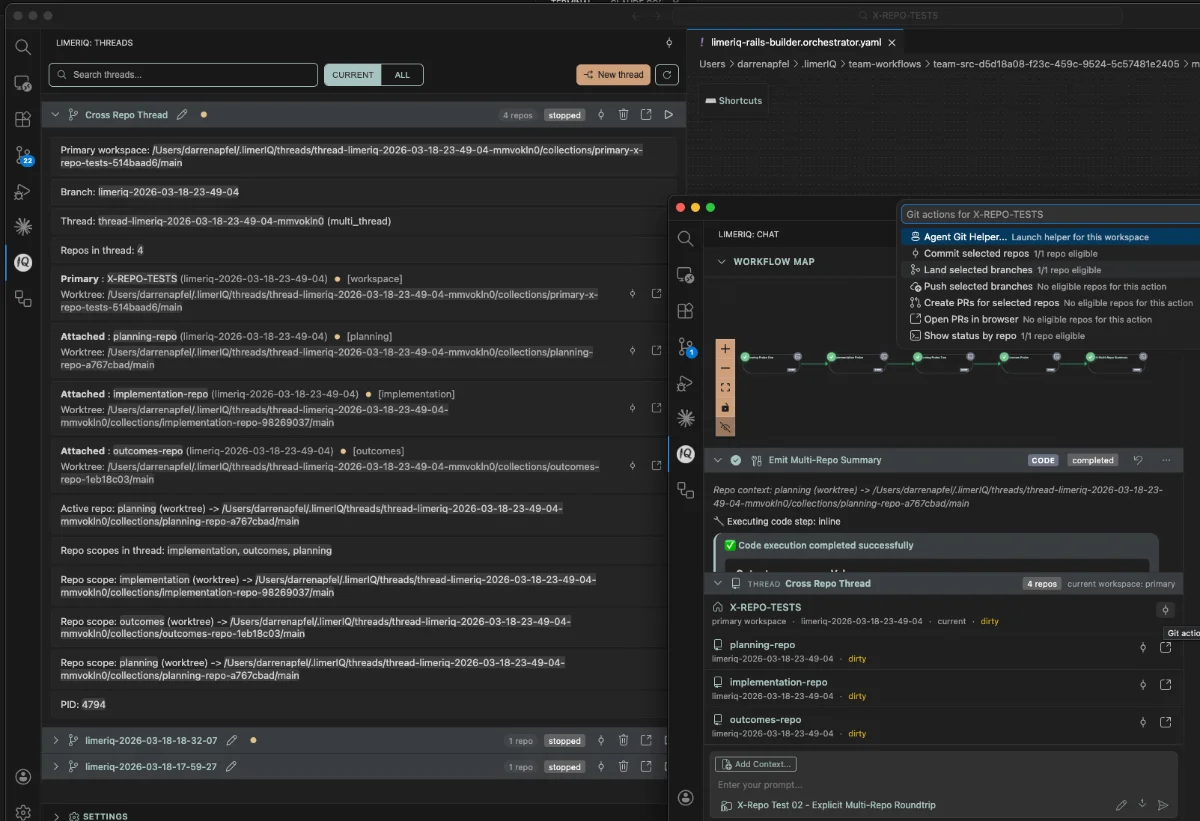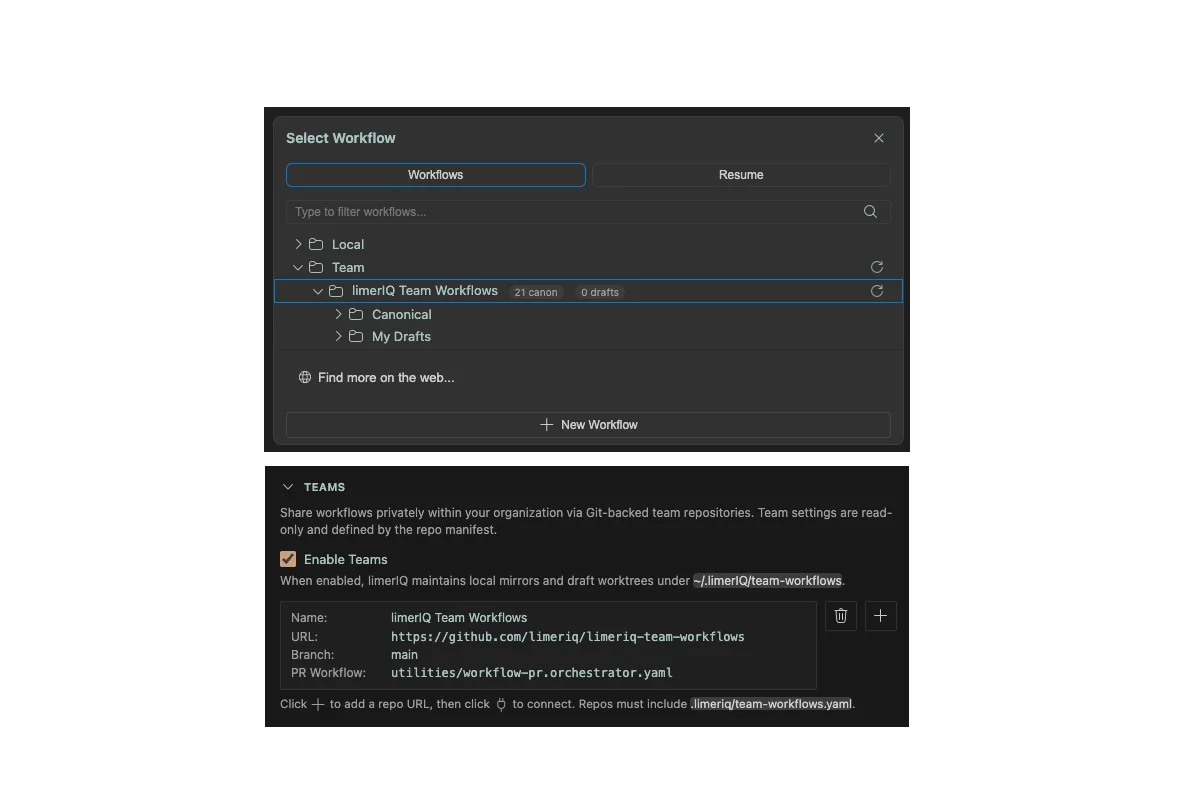
A workflow that only works while a developer is watching it is still a demo.

The desktop experience still matters. It is where people design workflows, inspect runs, and iterate on the process.
But if limerIQ is going to become part of real software delivery, the product has to survive a more serious test:
can the workflow run when nobody is sitting in front of VS Code?
That is the line between an interesting local tool and an execution layer.
This release moves limerIQ much closer to the second category.
The Runner Story Is Now Real
limerIQ now has a real headless runner path.
That includes:
- standalone workflow execution for CI and automation environments
- queue processing for runner workflows
- deploy-oriented CLI surfaces
- approval routing for actions that exceed autonomy thresholds
- reporter pipelines for publishing results back to systems like GitHub
- workspace management based on isolated worktrees
This is not just "you can technically call the CLI from a shell script." It is the beginning of a proper runner model.
That matters because teams do not want AI help only when a developer remembers to click a button. They want governed automation that can participate in the delivery system itself.
What Headless Actually Means Here
Headless does not mean "unsupervised and reckless."
In limerIQ, the headless model is explicitly tied to governance.
The runner can execute workflows in GitHub Actions, on self-hosted infrastructure, or locally without the IDE, but it still runs inside the same orchestration system:
- the same workflow definitions
- the same repo routing
- the same worktree model
- the same approval logic
- the same trust-chain steps
That continuity matters. A product does not become serious just because it has a CLI. It becomes serious when the non-interactive path obeys the same rules as the interactive one.
Autonomy Needs a Gate
One of the more important pieces in the runner architecture is that autonomy is not assumed.
The system includes an autonomy gate, trust scoring, and approval routing. In other words, limerIQ can distinguish between actions that should proceed automatically and actions that should route to approval because the trust threshold is not high enough.
That is the right shape for autonomous delivery work.
It means the product is not making the naive claim that "headless" and "fully trusted" are the same thing. It is giving the runtime a way to escalate when the action is more consequential than the current autonomy level should allow.
That is a much more believable foundation for automation.
The Delivery Use Cases Get Better Fast
Once the headless path exists, a lot of previously awkward workflows start to make sense:
- PR guard that runs on every pull request
- CI triage that kicks in the moment a pipeline fails
- release gating that assembles evidence before a promotion decision
- repo hygiene or maintenance flows on a schedule
- initiative bundles that run through a pipeline instead of living in one person's editor
This is the point where limerIQ starts to fit into SDLC machinery instead of orbiting around it.
And that shift is exactly what the relaunch is about.
Headless Safety Is the Whole Point
There is also a harder truth here:
headless execution is only useful if it fails safely.
That is why limerIQ's headless permission model matters so much. By default, headless runs do not get a magical pass. Actions that would normally require approval are denied unless they are explicitly auto-approved under the configured rules.
That is the correct default for unattended execution.
You can loosen the model deliberately when you mean to. What you should not get is a product that quietly becomes less safe the moment it leaves the IDE.
That is one of the reasons the runner story feels important in this release. It is not just about more places to run limerIQ. It is about carrying governance into those environments instead of abandoning it there.
Today Versus Tomorrow
There is still more to build in the long arc of hosted and fully managed execution. We are not pretending otherwise.
But it is also important not to understate what is already possible.
Today, an enterprising team can already run limerIQ in CI, on self-hosted runners, or on infrastructure they control. They can use the runner model, worktree isolation, trust-chain steps, and approval policies right now.
That means the "headless/autonomous" story is no longer speculative. It is early, but it is real.
Why This Changes the Product Category
This is one of the features that most clearly changes how limerIQ should be understood.
If the product only helped people orchestrate better agent sessions in the IDE, it would still be useful. But it would remain close to the category of developer assistant tooling.
Once the workflow can leave the IDE and still carry its guardrails, permissions, repo routing, evidence chain, and approval model with it, the product starts looking much more like delivery infrastructure.
That is the bigger shift.
limerIQ is moving from "tooling around coding agents" toward "governed execution for software delivery systems."
Headless execution is one of the reasons that sentence is now true.