
Acceptance Test Driven Development: From Spec to Passing Tests Automatically
Define acceptance criteria and let limerIQ generate code that passes those tests. Test-first development accessible to non-engineers.
You know exactly what success looks like. You can describe the behavior you want in plain English: "When a user clicks 'Add to Cart', the item count should increase by one." But translating that clarity into working code requires technical skills you may not have, or developer time you cannot spare.
What if you could write acceptance tests in plain language and watch AI generate code until those tests pass?
That is Acceptance Test Driven Development (ATDD) with limerIQ, and it puts product specification directly in control of code behavior.
The Traditional Testing Gap
In most development processes, testing happens after implementation:
- PM writes requirements - Describes desired behavior
- Developer interprets - Translates requirements to code
- Developer writes tests - Based on their interpretation
- QA finds gaps - Requirements drift becomes visible
- Rework begins - Expensive late-stage corrections
The problem? The person who best understands what "success" looks like is rarely the person writing the tests. By the time misalignment surfaces, significant work has already been done.
Test-First Development: A Different Approach
ATDD flips the script. You define what passing looks like before any code is written:
- PM defines acceptance criteria - Plain language success conditions
- Tests are generated - Concrete, runnable validations
- Code is written - With passing tests as the goal
- Validation loops - Iterate until all tests pass
- Done means done - No interpretation gaps
The acceptance criteria become the source of truth. Code is correct when tests pass. There is no ambiguity about what "done" means.
How limerIQ Makes ATDD Accessible
Traditional ATDD requires technical skills to write executable tests. limerIQ bridges that gap, letting product people define success criteria while the system handles the technical translation.
Phase 1: Capture Your Success Criteria
You describe acceptance criteria conversationally:
"The user registration form should:
- Require email and password fields
- Validate email format before submission
- Show an error if password is less than 8 characters
- Redirect to dashboard on successful registration
- Send a welcome email to the new user"
The system helps refine these criteria through conversation:
- Are there edge cases to consider?
- What error messages should appear?
- What does the happy path look like step-by-step?
This is where you have the conversation about what success looks like. The AI helps you think through edge cases and clarify ambiguous requirements, acting as an experienced product partner.
Phase 2: Generate Executable Tests
From your plain-language criteria, the system generates real test cases. You see the tests before any code is written. Each test maps clearly to one of your acceptance criteria:
- Test: "should require email and password fields"
- Test: "should validate email format"
- Test: "should require password of at least 8 characters"
- Test: "should redirect to dashboard on success"
- Test: "should send welcome email"
If a test does not match your intent, refine it now rather than after implementation. This is your opportunity to catch misunderstandings when changes are cheap.
Phase 3: Human Review Checkpoint
Before implementation begins, you review the generated tests:
"Here are the 7 tests I created from your acceptance criteria. Do these accurately capture your requirements? Any scenarios missing? Ready to proceed to implementation?"
This checkpoint is crucial. You are confirming that the tests represent your vision of success. Once you approve, implementation proceeds with a clear target.
Phase 4: Implementation with Validation Loop
With clear acceptance tests defined, the system writes code targeted at passing those tests. This is not open-ended coding; it is targeted problem-solving with a concrete goal: make all tests green.
After implementation, the system runs the tests. If any fail, it analyzes the failure and iterates:
"5 of 7 tests passing. Working on: email validation and welcome email sending..."
This loop continues until all acceptance tests pass. You do not ship code that fails your success criteria.
If the system cannot pass all tests after several attempts, it escalates to you rather than spinning indefinitely. You can then provide guidance, adjust the criteria, or bring in additional help.
Phase 5: Completion and Documentation
When all tests pass, the workflow commits the implementation and generates documentation. The acceptance tests themselves serve as living documentation of what the feature does.
What PMs Control
ATDD with limerIQ gives product managers direct influence over code behavior:
| Control Point | What You Define |
|---|---|
| Acceptance Criteria | The specific behaviors that constitute success |
| Test Review | Validation that tests match intent before coding |
| Definition of Done | Tests passing = feature complete |
| Scope Boundaries | What tests do NOT cover is explicitly out of scope |
You are not writing code, but you are defining what correct code looks like.
Real Benefits for Non-Technical Stakeholders
Clarity Before Development
Writing acceptance criteria forces you to think through edge cases before coding starts. "What should happen if the user enters an invalid email?" becomes a decision you make upfront, not a surprise you discover in QA.
No Interpretation Drift
Tests are a contract. "Is this what you meant?" becomes "Run the tests." If all tests pass, the feature meets your criteria. If any test fails, you know exactly what is not working.
Progress Visibility
"3 of 7 tests passing" is more meaningful than "about halfway done." You can see exactly which criteria are met and which need more work.
Regression Protection
Those tests remain in the codebase, catching future breakages. If someone later changes code in a way that violates your acceptance criteria, the tests will fail. Your requirements are protected automatically.
Documentation by Default
Acceptance tests document expected behavior for new team members. "What should this feature do?" is answered by reading the tests.
The Visual Workflow Experience
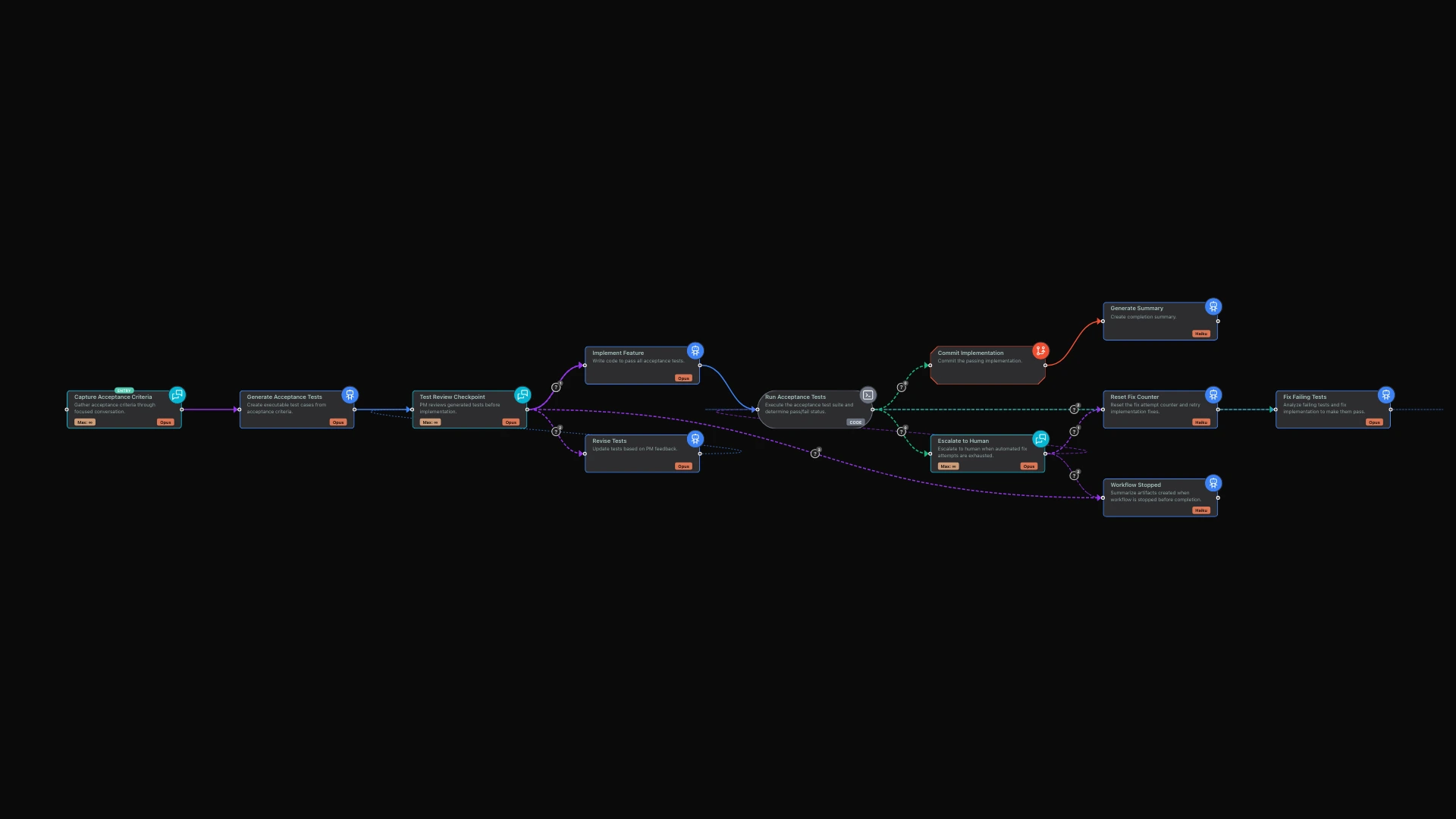
In limerIQ's visual editor, the ATDD workflow appears as a clear pipeline: criteria capture, test generation, review checkpoint, implementation with validation loop, completion.
The validation loop is visually distinct - you can see the iterate-until-passing pattern. Progress indicators show how many tests are passing and which are still being worked on.
For teams, this visibility creates confidence. Stakeholders can see that implementation is driven by explicit criteria, not developer interpretation. Engineers can see exactly what they need to build toward. Everyone shares a definition of "done."
The Validation Loop: Iteration Without Frustration
The validation loop is the core of ATDD. Instead of one-shot implementation, the workflow iterates:
Implement -> Test -> Fail -> Fix -> Test -> Fail -> Fix -> Test -> Pass
Each iteration is tracked. If the loop exceeds a threshold (typically 3 attempts), it escalates to human intervention rather than spinning indefinitely.
This pattern mirrors how experienced developers actually work: write, test, adjust, repeat. The workflow automates the cycle while keeping you informed of progress.
When ATDD Works Best
ATDD is particularly effective for:
- User-facing features with clear behavioral expectations
- Form validation and error handling
- Business logic with specific rules and conditions
- API endpoints where inputs and outputs are well-defined
- Integration points with external systems
It is less suited for:
- Exploratory work where requirements are unclear
- Performance optimization (hard to specify as acceptance tests)
- UI polish and visual design
Getting Started with ATDD
To try acceptance-test-driven development:
- Define your feature in terms of observable behaviors
- Open the ATDD workflow in limerIQ with your feature description
- Answer questions about edge cases and error scenarios
- Review generated tests to confirm they match your intent
- Approve implementation once all tests pass
The workflow handles test generation, implementation, and validation. You focus on defining what success looks like.
The PM as Quality Gatekeeper
Traditional quality assurance catches bugs after they exist. ATDD prevents bugs by defining correctness upfront.
As a PM using ATDD:
- You define quality through acceptance criteria
- You verify tests before implementation
- You control scope through what tests do and do not cover
- You ship with confidence because "done" has a concrete meaning
Your product vision is encoded directly into the test suite. Code that passes your tests delivers your requirements.
Related articles: