
Building Your AI Center of Excellence: Scaling limerIQ Across the Organization
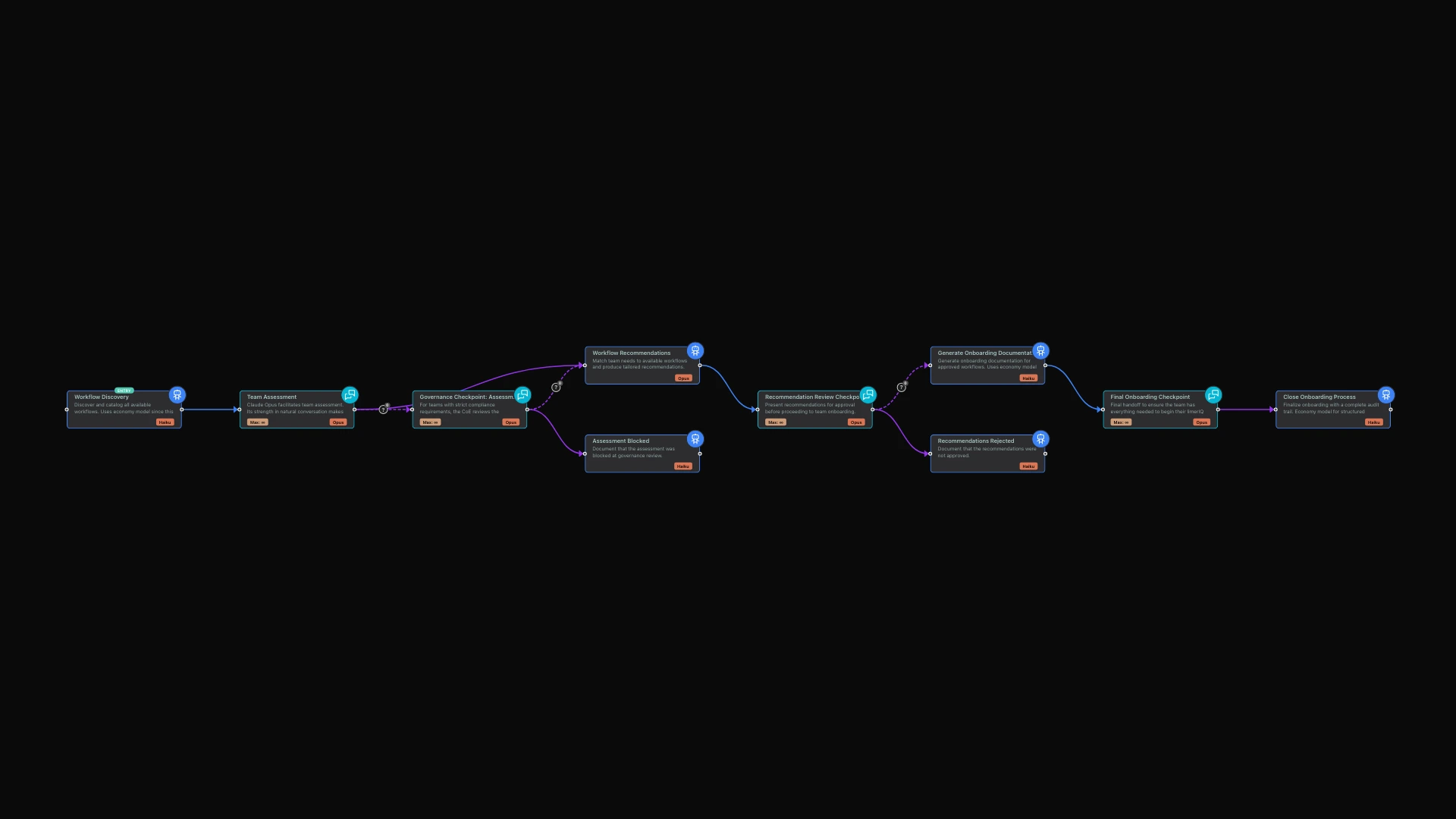
A comprehensive multi-phase workflow for enterprise adoption of AI orchestration tools. This workflow guides organizations through workflow discovery, team assessment, compliance-aware recommendations
Target Audience: Enterprise Architects, Staff Engineers, Technical Leaders
The Challenge of Enterprise AI Adoption
Every successful technology adoption follows a familiar pattern. A pilot team demonstrates value. Other teams notice. Demand spreads organically. And then chaos ensues.
Without governance, you end up with fragmented practices: different teams using different prompts, different approaches, different quality standards. Knowledge silos emerge. Costs spiral. Security risks multiply.
The solution is not to restrict adoption. The solution is to build infrastructure that scales it responsibly. This is the role of an AI Center of Excellence (CoE), a team that enables consistent, governed, efficient AI-assisted development across the entire organization.
limerIQ provides the technical foundation for this infrastructure through workflow marketplaces, reusable configurations, and governance frameworks.
The Four Pillars of an AI Center of Excellence
Pillar 1: Workflow Marketplaces
A workflow marketplace is a curated collection of reusable, vetted workflows that teams can adopt and customize. Instead of every team reinventing common patterns, they draw from a shared library.
The marketplace approach provides several benefits.
Consistency: All teams start from validated templates that encode best practices. When the security team creates a security review workflow, every team that adopts it inherits the security team's expertise.
Speed: Teams adopt proven workflows instead of building from scratch. A new team can be productive with AI-assisted development in days rather than months.
Quality: Central review ensures workflows meet security and compliance standards before they enter the marketplace. Teams adopting marketplace workflows inherit this vetting.
Learning: Teams discover patterns they did not know existed. Browsing the marketplace becomes a form of organizational learning.
Consider the workflow categories that benefit most from centralization. Onboarding workflows create consistent new-hire experiences. Code review workflows establish uniform quality standards. Release workflows ensure predictable release processes. Compliance workflows maintain regulatory consistency. Discovery workflows standardize product development processes.
Pillar 2: Reusable Configurations
The behavior of AI in your workflows depends on configuration: what expertise the AI brings, what communication style it uses, what constraints it operates under. An organization-wide configuration library ensures consistent AI behavior across teams.
Strategic configurations for enterprise adoption include:
Domain Experts: Configurations that embody your organization's specific domain knowledge. Financial services regulations, healthcare compliance, your particular tech stack. These configurations encode expertise that would otherwise require specialized training.
Quality Gates: Configurations focused on enforcement. Security reviewers, compliance auditors, architecture validators. These configurations ensure consistent standards regardless of which team uses them.
Facilitators: Configurations optimized for human interaction. Discovery facilitators, review presenters, checkpoint conductors. These configurations create consistent user experiences across different workflows.
The configuration library enables specialization without fragmentation. A security-focused configuration in Team A behaves identically to the same configuration in Team B.
Pillar 3: Governance Frameworks
Enterprise AI adoption requires governance at multiple levels.
Approval Workflows: Human checkpoints for high-risk decisions. Category A changes (infrastructure, security, database schema) require manager approval before AI proceeds. These gates are built into workflows rather than bolted on afterward.
Audit Trails: Complete documentation of AI-assisted decisions. Documentation scaffolding automatically creates comprehensive execution logs. When auditors ask what happened and why, the answers are available.
Cost Controls: Budget allocation by team, project, or workflow type. Strategic model selection (using economy models for routine tasks, premium models for critical decisions) reduces costs while maintaining quality. Cost tracking shows exactly where AI budget is going.
Access Controls: The permission system ensures AI cannot access tools or data beyond what is explicitly authorized. Different teams can have different permission levels based on their needs.
Pillar 4: Team Enablement
The Center of Excellence is not about gatekeeping. It is about enablement.
Training: Help teams understand workflow patterns and when to apply them. The Center of Excellence creates learning resources, runs workshops, and answers questions.
Customization: Support teams in adapting marketplace workflows to their specific needs. Not every workflow fits every team perfectly, and the CoE helps teams make appropriate modifications.
Innovation: Provide a path for teams to contribute new workflows back to the marketplace. The best workflows often come from teams solving real problems, and the CoE helps codify those solutions for broader adoption.
Support: Assist with debugging, optimization, and scaling challenges. When teams encounter issues, the CoE provides expertise and assistance.
Workflow Discovery: The Foundation of Scale
Before teams can adopt workflows, they need to find them. The Center of Excellence establishes discovery mechanisms that help teams find relevant patterns.
Effective discovery includes several elements. A searchable catalog allows teams to browse available workflows by category, use case, or team. Metadata enrichment adds descriptions, prerequisites, and recommendations to each workflow. Assessment tools help teams evaluate which workflows fit their needs. Onboarding guidance provides documentation for adopting selected workflows.
This discovery capability enables self-service adoption. Teams browse the catalog, identify relevant workflows, and receive tailored onboarding documentation, all without requiring CoE involvement in routine adoptions.
Team Onboarding Pattern
New teams adopting limerIQ benefit from structured onboarding that assesses their needs, recommends appropriate workflows, customizes configuration, and validates setup.
The assessment phase determines what types of work the team does, what pain points exist, and what compliance requirements apply. Different teams have different needs, and effective onboarding starts with understanding those needs.
The recommendation phase matches assessed needs to marketplace workflows. Based on assessment, which workflows fit the team's work patterns? The CoE maintains knowledge about which workflows work well for which situations.
The customization phase adapts configuration for team-specific needs. What domain expertise should the AI bring? What constraints should apply? What model preferences make sense for this team's work?
The validation phase confirms the team can successfully execute workflows with proper permissions. Before declaring onboarding complete, verify that everything works as expected.
This structured approach reduces time-to-productivity for new teams while ensuring they adopt consistent practices from the start.
Governance Checkpoints in Practice
Enterprise workflows require human oversight at critical decision points. Effective governance checkpoints share several characteristics.
Present Information Clearly: Summarize what the AI has done and what it proposes to do next. Stakeholders should not need to dig through logs to understand the situation.
Enable Informed Decisions: Provide enough context for humans to evaluate quality and appropriateness. The checkpoint should contain everything needed to make a good decision.
Record Rationale: Capture the decision and reasoning for audit trails. When questions arise later, the answers should be available.
Support Iteration: Allow for feedback incorporation before proceeding. Not every decision is binary; sometimes the right answer is "yes, but adjust this first."
Cost Optimization at Scale
Enterprise AI budgets matter. The Center of Excellence should establish guidelines for cost-effective model selection that teams follow consistently.
For discovery and planning phases, use premium models. These are high-value decisions where quality directly impacts outcomes. The investment in getting these decisions right pays dividends throughout subsequent phases.
For execution phases, use economy models. When specifications are clear and outputs are well-defined, premium models add cost without proportional value.
For review and synthesis phases, use premium models. Judgment-intensive tasks that require nuanced analysis benefit from premium reasoning.
For documentation phases, use economy models. Formatting and presentation tasks do not require deep reasoning.
A typical enterprise workflow can achieve 40-60% cost reduction through strategic model selection without sacrificing quality on critical decisions. At enterprise scale, these savings are substantial.
Building Your Marketplace
To establish an organizational workflow marketplace, follow a phased approach.
Start with proven patterns. Adopt established workflow templates as foundations. Do not try to invent everything from scratch; leverage existing best practices.
Categorize by use case. Group workflows by function: development, review, documentation, compliance. Clear categorization makes discovery easier.
Add organizational customizations. Create configurations that encode your organization's standards and expertise. These customizations transform generic workflows into workflows tailored for your context.
Establish contribution guidelines. Define how teams submit new workflows for marketplace inclusion. Good workflows often emerge from teams solving real problems, and the contribution process captures that innovation.
Maintain quality. Review submitted workflows for security, compliance, and best practices before marketplace inclusion. The marketplace should be a trusted source, not a dumping ground.
Enable discovery. Implement catalogs and search capabilities that help teams find relevant patterns. The best workflow is useless if teams cannot find it.
Measuring Success
Track these metrics to evaluate Center of Excellence effectiveness.
Adoption Metrics: Number of teams using marketplace workflows, workflow execution frequency, workflow diversity across teams. These metrics show whether the marketplace is providing value.
Quality Metrics: Defect rates before and after workflow adoption, time-to-resolution for common tasks, compliance audit findings. These metrics show whether workflows are improving outcomes.
Efficiency Metrics: Cost per workflow execution, time savings versus manual processes, onboarding time for new teams. These metrics show whether the CoE is delivering ROI.
Governance Metrics: Approval checkpoint completion rates, audit trail completeness, permission violation attempts. These metrics show whether governance is working.
The ROI of a Center of Excellence
Organizations that establish AI Centers of Excellence see returns in multiple dimensions.
Consistency improves because all teams follow established patterns. Quality becomes predictable rather than variable.
Speed improves because teams adopt proven workflows rather than building from scratch. Time-to-productivity for new teams decreases dramatically.
Cost decreases because strategic model selection becomes the norm rather than the exception. Across hundreds of workflow executions daily, the savings compound.
Risk decreases because governance is built in from the start. Security and compliance concerns are addressed systematically rather than reactively.
Conclusion
Scaling AI-assisted development across an enterprise requires infrastructure, not just tools. limerIQ provides the technical foundation: workflow orchestration, configuration management, governance integration, multi-provider flexibility.
The Center of Excellence provides the organizational foundation: curated marketplaces, consistent practices, governance frameworks, team enablement.
Together, these foundations enable organizations to move from pilot projects to enterprise-wide adoption while maintaining the consistency, security, and cost control that enterprise environments demand.
Your organization's AI adoption can be systematic rather than chaotic. It can scale with governance rather than despite it. It can accelerate development while maintaining the controls your enterprise requires.
That is the promise of a well-designed AI Center of Excellence, and limerIQ provides the platform to deliver on that promise.
Next Steps:
- Assess your current AI adoption status: how fragmented are team practices?
- Identify the first three workflow candidates for marketplace standardization
- Define governance requirements for your organization's AI-assisted development
- Explore the Center of Excellence templates in the limerIQ marketplace
Related Articles: