
Onboarding Engineers in Days, Not Months: Auto-Generated Codebase Documentation
For Engineering Team Leads looking to accelerate new hire productivity
You have hired a talented engineer. They have the skills, the enthusiasm, and the drive to contribute. But for the next three to six months, they will be operating at a fraction of their potential while they navigate your codebase, decipher tribal knowledge, and piece together how your systems actually work.
This is the hidden cost of engineering onboarding, and it is killing your team's velocity.
The Documentation Paradox
Every engineering team knows they should have comprehensive codebase documentation. Architecture diagrams, dependency maps, testing guides, extension surfaces. The problem is that documentation requires the same deep understanding that makes onboarding slow in the first place. Senior engineers who know the codebase well enough to document it are too busy building features to write docs.
The result is a vicious cycle: poor documentation slows onboarding, slow onboarding overloads senior engineers, overloaded engineers cannot write documentation.
limerIQ breaks this cycle with exploration workflows that systematically analyze your codebase and produce the exact documentation new hires need.
What Comprehensive Onboarding Documentation Looks Like
Effective onboarding documentation is not a single README. It is a coordinated set of documents that answer the questions new engineers actually ask:
Codebase Overview - The map of the territory. Entry points, module structure, build systems, and execution flow. This is where an engineer learns "how do I run this thing?"
Architecture Guide - The design decisions and patterns. Data flow, core abstractions, error handling strategies, and configuration systems. This answers "why is it built this way?"
Dependencies Reference - The external world. Package dependencies, API integrations, external services, and system requirements. New engineers need to know "what else does this talk to?"
Testing Guide - The quality safety net. Test structure, frameworks, CI/CD pipelines, coverage expectations, and test utilities. This covers "how do I know if I broke something?"
Extension Surface - The growth points. Plugin registries, extension interfaces, hooks, configuration extensions, and resource templates. This shows "how do I add new capabilities?"
Together, these five documents provide a new engineer with a complete mental model of your system in a format they can reference as they work.
The Scout-and-Specialist Approach
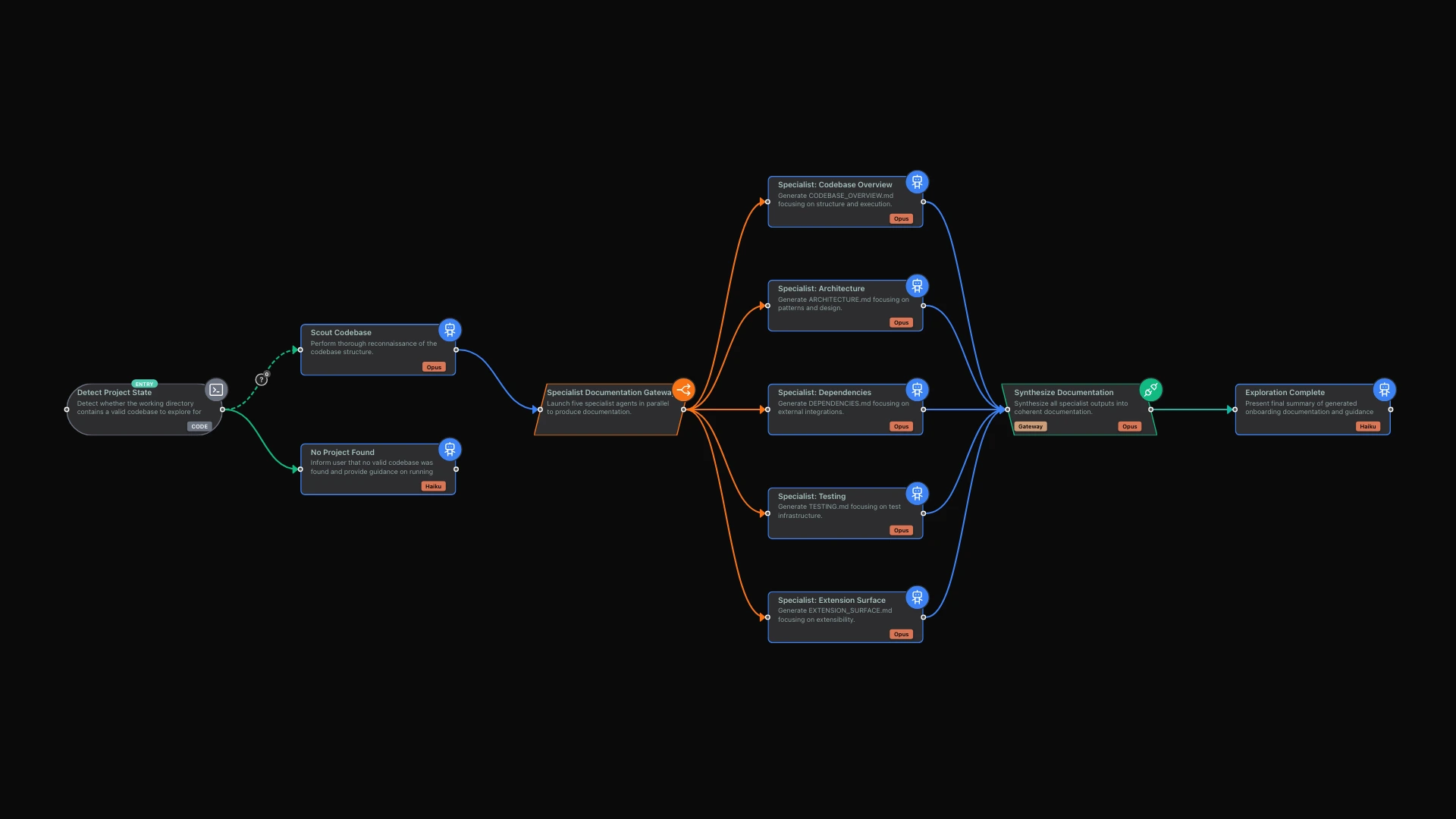
Rather than asking senior engineers to document from memory, limerIQ exploration workflows systematically analyze your actual codebase. The process uses a scout-and-specialist pattern that mirrors how a thorough consultant might approach documenting an unfamiliar system.
First, a reconnaissance phase performs a thorough survey of your codebase. The system identifies entry points, key directories, build and test systems, and the extension surface. This provides a high-level map that guides deeper exploration.
Then, five specialist analyses run in parallel, each focused on producing one of the five documentation sections. Each specialist receives the reconnaissance findings and dives deep into their specific domain. They examine source files, analyze patterns, and produce documentation with precise references back to the actual code.
Finally, a synthesis phase resolves any conflicts between specialist findings, merges overlapping discoveries, and ensures consistency across all five documents.
The entire process runs autonomously. You point the workflow at your codebase through the visual editor and come back to find comprehensive documentation ready for review.
A Practical Experience
Using limerIQ's visual workflow editor, you select the codebase exploration workflow, point it at your project, and initiate the analysis. The interface shows you progress as each phase completes.
The workflow produces five comprehensive documents covering your architecture, codebase overview, dependencies, testing approach, and extension surface. Each document includes citations to specific source files and line numbers, so new engineers can drill down from documentation to actual code when they need deeper understanding.
Key Benefits of the Automated Approach
Focused Analysis
The workflow spawns specialized analysis agents, each with a specific mission. This keeps each analysis focused and prevents the confusion that comes from trying to document everything at once. The result is clearer, more actionable documentation.
Guaranteed Completeness
The workflow ensures all five documentation areas are covered. If any section is incomplete after the exploration phase, the system automatically performs additional analysis. You never receive partial documentation.
Traceable Citations
All findings follow a consistent citation format that makes it easy for new engineers to jump from documentation to source code. No guessing about which file a pattern appears in. Every claim in the documentation can be verified against the actual implementation.
Efficient Parallel Execution
The specialist analyses work simultaneously, dramatically reducing the time needed to generate comprehensive documentation compared to sequential approaches. What might take a senior engineer weeks to document manually happens in under an hour.
Keeping Documentation Fresh
Codebases change. A one-time documentation effort quickly becomes stale. The exploration workflow includes a freshness mechanism that tracks when documentation was last generated and what has changed since.
When you run the workflow periodically, it compares the current state against the last explored version. If changes are small, a targeted refresh updates only the affected sections. If changes are substantial, a full re-exploration runs.
This means you can schedule regular documentation updates, or trigger them automatically in your CI pipeline, to keep onboarding materials synchronized with your actual codebase.
The ROI of Automated Documentation
Consider the math. If a new engineer takes three months to reach full productivity instead of six months, you have effectively gained three months of engineering output. For a team that hires four engineers per year, that is twelve months of additional productive engineering time.
The exploration workflow takes about thirty minutes to run. Even if you run it weekly, the time investment is trivial compared to the onboarding acceleration it enables.
Beyond the productivity gains, there are qualitative benefits:
- Consistency: Every new hire receives the same high-quality documentation
- Accuracy: Documentation reflects the actual codebase, not outdated memories
- Confidence: New engineers can trust the documentation they are reading
- Reduced interruptions: Senior engineers field fewer basic questions
Getting Started
- Open limerIQ's visual workflow editor and select the codebase exploration template
- Configure the workflow to point at your codebase
- Run the workflow and let it perform its analysis
- Review the generated documentation for accuracy and completeness
- Share with new hires and collect their feedback
- Schedule periodic re-runs to keep documentation current
The workflow handles the heavy lifting of analyzing and documenting your codebase. Your role shifts from writing documentation to reviewing and refining it - a far better use of senior engineering time.
What's Next?
Comprehensive onboarding documentation is one piece of the puzzle. For parallel code review that eliminates your team's review bottleneck, see The Parallel Code Review: How limerIQ Eliminates Your Team's Review Bottleneck. For encoding your team's best practices into automated checks, explore Codifying Your Team's Best Practices: Custom Personas and Validation Rules.
Ready to transform your engineering onboarding? Try limerIQ today and generate your first codebase documentation in under an hour.