
Multi-Provider AI Strategy: Why Vendor Lock-In is the Wrong Approach
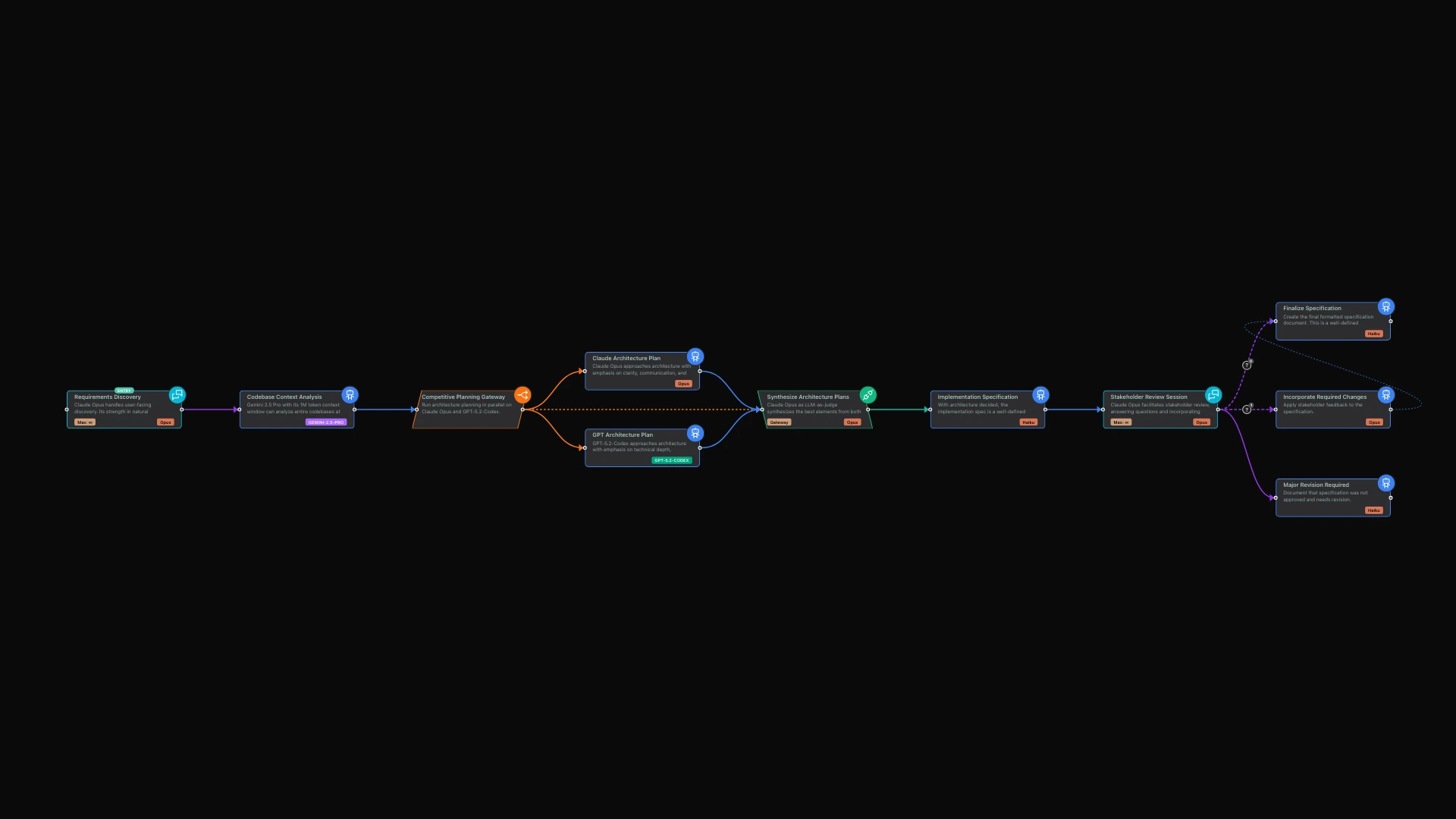
A sophisticated workflow that demonstrates strategic model selection across Claude, GPT, and Gemini to create comprehensive technical specifications. Uses competitive parallel planning with LLM-as-jud
Target Audience: Enterprise Architects, Staff Engineers, Technical Leaders
The Vendor Lock-In Trap
When organizations adopt AI for software development, many fall into a familiar trap: selecting a single AI provider and building their entire infrastructure around it. This creates the same vendor dependency that has plagued enterprise IT for decades with databases, cloud providers, and development tools.
The problem is not just contractual. Each AI provider excels at different tasks. Claude demonstrates remarkable strength in planning, communication, and documentation. GPT models shine in deep architectural reasoning and complex, long-running coding tasks. Gemini offers massive context windows ideal for synthesizing large codebases or documentation sets.
Locking into a single provider means accepting mediocrity in areas where your chosen vendor is not the strongest.
The Multi-Provider Architecture
limerIQ addresses this challenge with a unified multi-provider architecture that treats Claude, GPT, and Gemini as interchangeable components within the same workflow. Through the visual workflow editor, you can design workflows that leverage each provider's strengths without writing integration code or managing multiple APIs.
The platform provides several key capabilities that make multi-provider orchestration practical:
Unified Output Format: All providers produce identical structured output, so your tooling, logging, and analytics work identically regardless of which model executes a step.
Per-Step Model Selection: Within the workflow editor, each step can specify its optimal model through a simple dropdown. Use Claude for planning, GPT for implementation, and Gemini for large-context synthesis.
Seamless Fallback: If a provider experiences issues, workflows can automatically route to alternatives without manual intervention.
Single Permission System: The same approval workflow governs all providers, maintaining consistent security posture across your entire AI infrastructure.
Strategic Model Selection
The key insight is that different tasks demand different strengths. Here is how we recommend allocating models across your workflows:
Planning and Communication: Claude
Claude excels at understanding user intent and requirements, breaking complex problems into manageable components, writing clear documentation and specifications, and handling human-facing interactive conversations. When your team needs to understand what is being built and why, Claude provides the clearest explanations.
Deep Architecture and Complex Coding: GPT
GPT models, particularly the Codex variants, demonstrate remarkable capability for long-running implementation tasks requiring sustained focus, complex architectural decisions with many interdependencies, senior-level coding tasks requiring deep reasoning, and debugging intricate issues across large codebases. The platform allows you to adjust reasoning intensity based on task complexity.
Large Context Synthesis: Gemini
Gemini offers context windows up to 1 million tokens, making it ideal for analyzing entire codebases at once, synthesizing documentation from multiple sources, processing large datasets or log files, and performing comparative analysis across many files.
Cost Optimization Through Strategic Selection
Multi-provider strategy is not just about capability. It is about economics.
Consider a typical development workflow and how strategic model selection reduces costs while maintaining quality:
During discovery, when you need accurate requirements gathering, premium models are essential. The investment in getting requirements right pays dividends throughout the project. During planning, architectural decisions warrant similar investment because these choices cascade through everything that follows.
However, implementation tasks with clear specifications can often use more economical models. When the requirements are well-defined and the output format is clear, you do not need premium reasoning. Similarly, documentation tasks with established templates can leverage faster, lighter models.
Quality reviews, on the other hand, benefit from premium models because catching bugs early saves far more than the incremental cost. The synthesis step that brings everything together also warrants premium reasoning.
By using economy-tier models for straightforward tasks and reserving premium models for complex decisions, organizations can reduce AI costs by 40-60% while maintaining quality where it matters most.
The Competitive Planning Pattern
One pattern unique to multi-provider architectures is competitive planning: running the same planning task on multiple models simultaneously, then synthesizing the best elements from each.
In the visual workflow editor, you create a parallel gateway that branches to multiple planning steps, each using a different AI provider. The results then flow into a synthesis step that combines the best insights from each approach.
This approach produces better architectures than any single model because different models catch different edge cases, synthesis combines complementary strengths, and disagreements between models highlight areas needing human review.
When Claude identifies user experience considerations that GPT missed, and GPT surfaces architectural patterns that Claude overlooked, the combined result exceeds what either could produce alone.
Enterprise Governance Considerations
Multi-provider deployments require thoughtful governance, and limerIQ addresses each concern:
Data Residency: Different providers have different data handling policies. The platform allows you to route sensitive tasks to specific providers based on compliance requirements.
Cost Allocation: Track spending by provider, team, and workflow type. The unified architecture enables consistent cost attribution across your entire organization.
Audit Trails: All provider interactions flow through the same logging infrastructure, creating complete audit trails regardless of which model executed which step.
Access Control: The permission system gates tool usage consistently across providers, preventing one provider from having broader access than another.
The User Experience
For teams using limerIQ, the multi-provider architecture is largely invisible. They design workflows visually, selecting models from a dropdown menu at each step. The platform handles the complexity of managing multiple API integrations, normalizing outputs, and routing requests.
What teams experience is workflows that simply work better. Planning phases produce clearer requirements. Implementation phases complete faster. Reviews catch more issues. Documentation reads more naturally. Each phase leverages the model best suited to its task.
The workflow editor makes it easy to experiment with different model allocations. Try GPT for a planning step and compare results with Claude. The visual interface makes A/B testing straightforward, and the cost tracking shows exactly what each approach costs.
Migration Path for Existing Workflows
Organizations with existing single-provider workflows can migrate incrementally. First, identify which steps take longest or produce the lowest quality. Then pilot alternative models on those specific steps. Measure the outcomes: quality, cost, and latency. Finally, optimize gradually, switching one step at a time and validating each change.
Because each workflow step is independent in the visual editor, changing one step's model requires no changes elsewhere. This incremental approach reduces risk while allowing teams to realize benefits immediately.
The Strategic Flexibility Advantage
Beyond immediate cost and quality benefits, multi-provider architecture provides strategic flexibility:
Negotiation Leverage: When renewal discussions arise with any provider, you have real alternatives that you are already using in production.
Risk Mitigation: Provider outages affect only some steps, not entire workflows. Your critical processes remain operational even when individual providers experience issues.
Innovation Access: New models from any provider can be adopted immediately through the workflow editor. When OpenAI releases a new capability or Anthropic improves Claude's reasoning, you can incorporate those improvements into relevant workflow steps the same day.
Competitive Analysis: Direct comparison of providers on your actual workloads gives you data-driven insights about which models truly perform best for your specific use cases.
Conclusion
Vendor lock-in is a familiar problem with a familiar solution: abstraction and portability. limerIQ provides this abstraction for AI, enabling organizations to use each provider where it excels while maintaining unified tooling, governance, and analytics.
The multi-provider approach is not about hedging bets. It is about recognizing that AI capabilities are complementary, not competitive. The best outcomes come from combining Claude's communication clarity with GPT's architectural depth and Gemini's context capacity.
The visual workflow editor makes this approach accessible to any team, regardless of their technical depth. Design workflows that leverage the full landscape of AI capabilities, optimize costs through strategic model selection, and maintain the flexibility to adapt as the AI landscape evolves.
Next Steps:
- Explore the multi-provider workflow templates in the limerIQ marketplace
- Review your existing workflows for multi-provider optimization opportunities
- Read the Cost Optimization Guide for detailed pricing strategies
Related Articles: