
Codifying Your Team's Best Practices: Custom Personas and Validation Rules
For Engineering Team Leads looking to encode institutional knowledge into automated workflows
Every engineering team has a playbook. Style guides, architecture patterns, code review checklists, security requirements, testing standards. The problem is that playbooks live in wikis nobody reads, in the heads of senior engineers who are too busy to mentor, and in Slack threads that scroll out of sight.
When a new hire asks "how do we do things here?" the answer is often "well, it depends" followed by forty-five minutes of tribal knowledge transfer.
limerIQ changes this by letting you encode your team's best practices directly into automated workflows. Custom personas carry institutional expertise. Validation gates enforce standards automatically. The result is a system that teaches, guides, and enforces your team's conventions without requiring senior engineers to repeat themselves.
The Knowledge Encoding Problem
Engineering teams accumulate best practices over years. Someone learns the hard way that certain patterns cause production issues. Another engineer discovers an elegant approach to error handling. The team settles on naming conventions, testing strategies, and documentation standards.
This knowledge is valuable but fragile. It exists primarily in human memory. When those engineers leave or change teams, the knowledge goes with them. When the team grows faster than mentorship capacity allows, standards drift. When deadlines pressure developers to cut corners, best practices become optional.
The traditional solution is documentation. Write it down. Update the wiki. Maintain the style guide. But documentation has a fatal flaw: it requires humans to remember to read it and choose to follow it.
Personas: Your Team's Encoded Experts
limerIQ personas are specialized AI roles that carry expertise, priorities, and behavioral patterns shaping how the AI approaches tasks. Think of them as teaching an AI assistant to think like your best engineers.
A team security reviewer persona, for example, might carry your specific security standards:
- No secrets in code - use environment variables
- All user input must be validated and sanitized
- SQL queries use parameterized statements only
- Authentication tokens expire within 24 hours
- Sensitive data encrypted at rest and in transit
When assigned to a workflow step, the AI carries this context into every interaction. It knows your standards, understands your severity levels, and provides feedback consistent with how your senior security engineer would respond.
The power multiplies when you create personas for different aspects of your engineering culture:
- Architecture Reviewer: Knows your service boundaries, data flow patterns, and scaling strategies
- Testing Standards Expert: Understands your coverage requirements, test naming conventions, and fixture patterns
- Documentation Specialist: Enforces your documentation templates, API documentation standards, and inline comment requirements
- Performance Engineer: Carries knowledge of your performance budgets, caching strategies, and database optimization patterns
Each persona becomes a reusable encoding of expertise that any workflow can leverage. You build them once, and they enforce your standards forever.
Validation Gates: Automated Enforcement
Documentation that nobody reads is useless. Checklists that engineers skip under deadline pressure are useless. Enforcement that happens automatically, every time, is valuable.
limerIQ workflows can include validation gates - checkpoints that evaluate code against your standards and either pass or fail. These gates create natural enforcement points that ensure standards are met before work proceeds.
Consider a pre-merge validation workflow. When code is ready for review, it passes through gates that check:
- Security standards: Are there vulnerabilities, exposed secrets, or improper authentication?
- Architecture compliance: Does the code follow your patterns and respect module boundaries?
- Test coverage: Are there adequate tests, and do they follow your conventions?
- Style requirements: Does the code meet your formatting, naming, and documentation standards?
If the code passes all gates, the workflow continues to the next phase. If any gate fails, the workflow routes to remediation - providing specific feedback about what needs to change.
This is not a suggestion. This is enforcement. And it happens the same way every time, regardless of deadline pressure or reviewer availability.
The Standards Review Experience
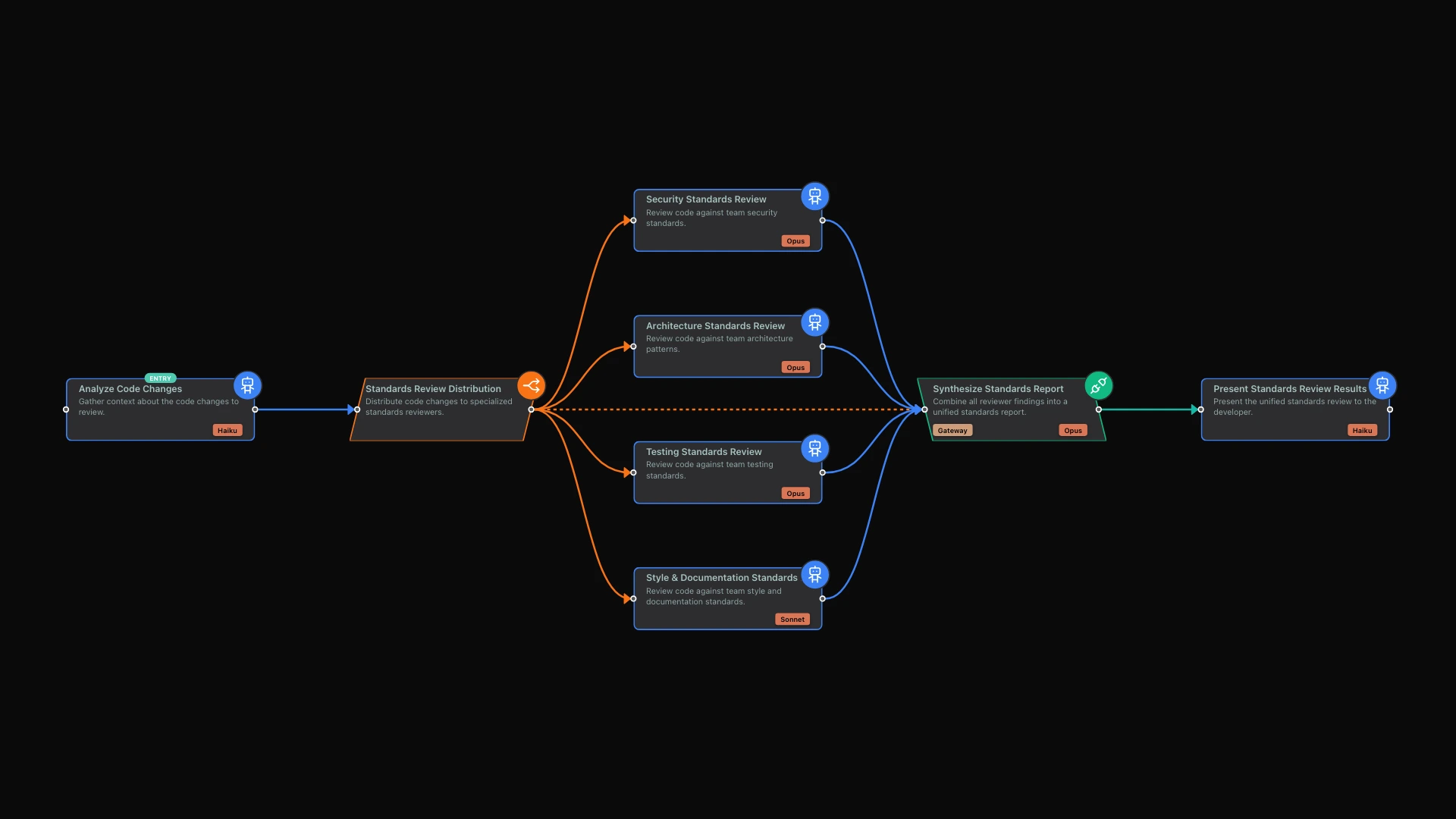
Using limerIQ's visual workflow editor, you can design a complete standards enforcement pipeline. Here is how a typical team standards workflow operates:
First, the system analyzes what changed. A lightweight initial phase examines the code changes, identifies affected files, and determines the scope of the review needed.
Then, four specialized reviewers analyze the changes simultaneously:
- A security reviewer checks for vulnerabilities, secrets exposure, and input validation issues
- An architecture reviewer validates patterns, boundaries, and dependencies
- A testing reviewer verifies test coverage, test quality, and proper fixture usage
- A style reviewer enforces naming conventions, formatting, and documentation standards
Each reviewer uses a custom persona carrying your team's specific standards. They do not apply generic best practices - they apply your best practices.
Next, the findings are synthesized. An integration phase combines all reviewer findings into a unified report, prioritizing issues and determining whether the changes meet your team's overall standards.
Finally, actionable feedback is generated. The developer receives developer-friendly guidance with specific remediation steps for any issues found.
The entire process runs automatically, producing consistent results regardless of who wrote the code or when they submitted it.
Building Your Persona Library
Start by auditing your team's existing standards. What do senior engineers consistently flag in code reviews? What patterns cause production issues? What conventions do you enforce?
For each category of standards, create a persona. Capture the specific requirements, severity levels, and common violations. Include the context that helps the AI understand not just what to check, but why it matters.
Your security reviewer persona might note that exposed secrets are critical violations because they create immediate production risk. Your architecture reviewer might explain that cross-module dependencies are high-priority issues because they complicate future refactoring.
This context helps the AI provide more nuanced, helpful feedback - the kind a thoughtful senior engineer would give, not just a mechanical rule check.
The Accumulating Knowledge Base
Every time you identify a new best practice, you have a decision: write it in a wiki that will be forgotten, or encode it in a persona that will be enforced.
Over time, your persona library becomes a living encoding of your team's engineering culture. New hires do not need to absorb years of tribal knowledge through osmosis. They work with workflows that carry that knowledge forward automatically.
When senior engineers move on, their expertise does not leave with them. It persists in the personas they helped create.
When your team identifies a new pattern to avoid or a new standard to enforce, adding it to the relevant persona ensures it applies immediately to all future work. The knowledge compounds rather than dissipating.
Beyond Code Review
The persona-and-validation pattern extends beyond code review:
- Onboarding Workflows: Use personas to provide team-specific guidance to new hires, ensuring they learn your conventions from day one
- Architecture Decision Records: Encode architectural principles in personas that guide design discussions and ensure consistency
- Incident Response: Capture your runbook knowledge in personas that guide debugging, ensuring consistent problem-solving approaches
- Documentation Generation: Personas that know your documentation standards produce consistent docs without manual review
Any workflow that benefits from specialized expertise can use custom personas to carry that expertise forward.
Getting Started
- Identify three to five categories of standards your team enforces most consistently
- Document the specific rules, severity levels, and context for each category
- Create personas through limerIQ's visual editor, encoding this knowledge
- Build a standards review workflow using these personas
- Run the workflow against a recent PR to see it in action
- Iterate on persona definitions based on whether they catch what your senior engineers would catch
The first iteration will not be perfect. Refine the personas based on real feedback. Over time, they become increasingly effective encodings of your team's expertise - experts that never leave, never forget, and never get too busy to review.
The Strategic Advantage
Teams that successfully encode their best practices gain a compounding advantage:
- Consistency: Every piece of code receives the same thorough review
- Scalability: Review capacity grows without adding headcount
- Onboarding: New engineers learn standards by working with them
- Retention: Institutional knowledge persists through team changes
- Quality: Standards are enforced, not just documented
Your team's best practices are too valuable to leave in wikis and memories. Encode them into personas and validation gates that enforce them automatically, consistently, and permanently.
What's Next?
Custom personas and validation rules are the foundation for encoding team knowledge. For parallelizing feature development across your team, see The Sprint Gateway Pattern: Parallel Feature Development Without Merge Hell. For automating the full ticket-to-PR pipeline, explore From Ticket to PR: Automating the Developer Workflow.
Ready to codify your team's best practices? Try limerIQ today and create your first team personas in under an hour.