
Fresh Context, Every Time: How limerIQ Prevents Context Pollution
A sophisticated multi-stage code review workflow that demonstrates limerIQ's fresh context management capabilities. Each review stage—discovery, security, performance, and synthesis—operates with a cl
The Hidden Problem With AI Conversations
Every developer who has used AI assistants knows the frustration. You start a conversation about implementing authentication, then ask about database schema design, then debug a CSS issue, then return to authentication -- and suddenly the AI is confused, mixing concepts from earlier in the conversation, or worse, confidently stating something incorrect based on outdated context.
This is context pollution.
In traditional AI interactions, context accumulates like sediment. Every question, every code snippet, every tangent becomes part of the growing conversation history. The AI cannot distinguish between what is currently relevant and what was relevant three hours ago. The result is hallucinations, wasted processing on irrelevant information, and confused reasoning from conflicting data.
For single-question interactions, this matters little. For complex software development workflows spanning multiple stages -- discovery, architecture, implementation, review, documentation -- context pollution becomes a serious problem.
The limerIQ Solution: Fresh Starts with Targeted Memory
limerIQ takes a fundamentally different approach. Each step in a workflow gets a fresh context window. The AI agent starts clean, without the accumulated noise of previous steps.
But fresh context alone creates a different problem: how does each step know what happened before? How do later stages access the decisions and discoveries from earlier ones?
The answer is targeted information transfer through three mechanisms:
- Structured data handoffs - Specific values passed explicitly between steps
- Persistent documents - Shared files that accumulate knowledge across the workflow
- Delegated deep dives - Sub-tasks that explore thoroughly and return clean summaries
How Information Flows Between Fresh Contexts
When you design a workflow, you explicitly declare what information each step produces and what information later steps need to receive. This creates a clean contract: each step knows exactly what inputs it will receive and what outputs it must produce.
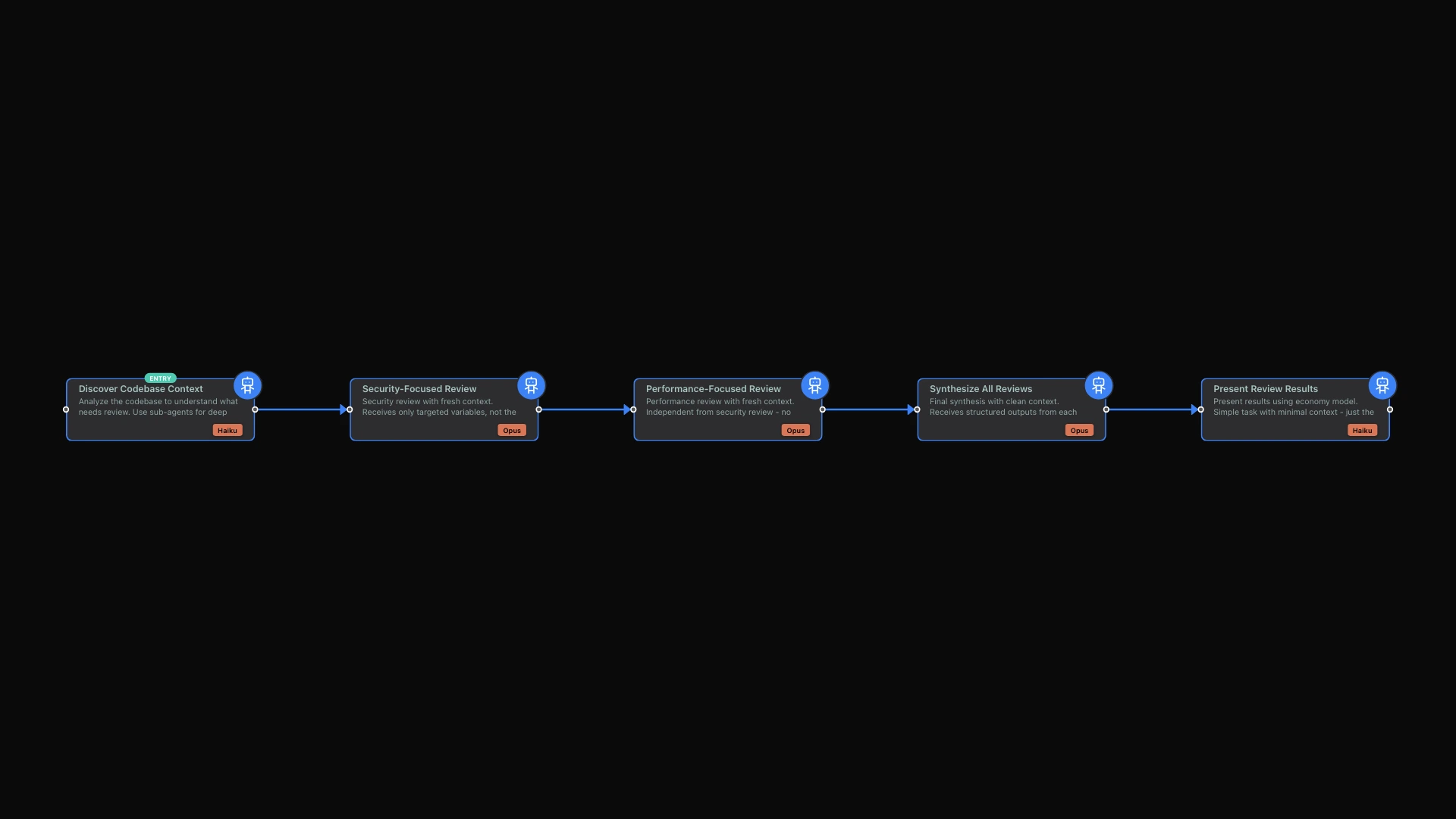
Consider a code review workflow with multiple review stages:
The discovery step analyzes the codebase and produces specific outputs: a description of what needs to be reviewed, a list of key files, and areas of concern. These are structured pieces of information, not a sprawling conversation history.
The security review step starts with a completely fresh context. It receives only the specific outputs from discovery: the scope description and file list. It does not receive the discovery step's internal reasoning, the files it read during exploration, or any tangential observations. It receives exactly what it needs -- nothing more.
This precision is transformative. The security reviewer focuses entirely on security concerns without being distracted by the discovery step's musings about code style or documentation gaps.
The performance review step similarly starts fresh. It receives the scope and files, but not the security review's analysis. Each reviewer operates independently, uncontaminated by the other's perspective.
The synthesis step receives structured summaries from both reviews: security score, security recommendation, performance score, performance recommendation. It does not inherit the full context of either review. It receives clean, organized information and can focus on producing a coherent final assessment.
Persistent Documents: Memory That Survives Context Boundaries
Structured data handoffs work well for specific values -- scores, file lists, recommendations. But what about detailed findings, nuanced observations, and accumulated insights?
This is where persistent documents shine. You define shared documents at the workflow level that exist across all steps. Any step can read these documents for context from previous stages and write its own contributions.
Imagine a review findings document that accumulates throughout the workflow:
- The discovery step writes a summary section describing what will be reviewed
- The security review step writes its detailed security findings
- The performance review step writes its detailed performance findings
- The synthesis step reads all sections to produce its final assessment
Each step can access detailed context from previous stages through this shared document, without inheriting the internal conversation state of those stages. The document becomes a shared knowledge base that exists outside any single AI context.
This is remarkably powerful. A security review can see the discovery summary without inheriting the discovery step's internal reasoning. The synthesis step can read detailed findings from all reviews without having any of those reviews' working context polluting its own.
Delegated Deep Dives: Thorough Exploration Without Contamination
Sometimes you need deep analysis. Tracing authentication flow through fifteen files. Understanding a complex dependency graph. Analyzing performance characteristics across multiple services.
In a traditional AI conversation, this deep dive would consume your entire context window. Every file read, every observation made, every tangent explored -- all of it becomes part of your context, relevant or not.
limerIQ offers a different pattern: delegated deep dives.
When a step needs deep analysis, it can spawn a sub-task that gets its own fresh context. The sub-task performs the deep dive -- reading dozens of files, tracing complex paths, exploring edge cases. When it completes, it returns a clean summary to the parent step.
The parent step's context remains uncontaminated. It receives the insights without the noise.
For example, a security review step might delegate: "Trace the authentication flow from login endpoint to session storage. Identify all points where user input is processed. Summarize security concerns in five bullet points."
The delegated task does the thorough exploration, reading every file in the authentication path. The security review step receives a focused five-point summary. Its context stays clean and focused on the overall security assessment.
This pattern is transformative for complex workflows. The orchestrating step maintains strategic clarity while delegating tactical deep dives to specialists that cannot pollute the main context.
Why This Architecture Produces Better Results
Consider a typical feature development workflow: discovery, architecture design, implementation planning, coding, testing, code review, documentation. Seven stages, each building on the previous.
In a traditional AI conversation, by the time you reach documentation, the context is polluted with implementation details, debugging tangents, and outdated architectural decisions that were revised mid-stream. The AI writing documentation might reference approaches that were abandoned, forget decisions that were made, or conflate concepts from different stages.
With fresh context at each stage:
- Discovery explores the codebase thoroughly and produces a clean summary
- Architecture receives that summary and produces design decisions, starting fresh
- Planning receives architecture decisions and produces implementation steps, starting fresh
- Implementation receives the plan and executes it, starting fresh
- Testing receives what was built and validates it, starting fresh
- Review receives implementation and test results and evaluates, starting fresh
- Documentation receives the full picture in structured form and writes clearly, starting fresh
Each stage operates at its best, unencumbered by the accumulated noise of earlier stages. Later stages receive structured summaries, not raw conversation history.
The result is clearer reasoning, fewer hallucinations, more efficient processing, and workflows that can scale to enterprise complexity without drowning in accumulated context noise.
Designing Workflows for Fresh Context
To take full advantage of fresh context architecture:
Define explicit outputs for each step. What specific information does this step produce that downstream steps will need? Name it, describe it, and the system ensures it flows correctly.
Use persistent documents for detailed findings. When a step produces detailed analysis that later steps might need, write it to a shared document. The document persists across context boundaries.
Delegate deep exploration when needed. If a step needs to read dozens of files or trace complex paths, delegate that exploration to a sub-task that returns a clean summary.
Keep each step focused on its specific responsibility. When steps have clear, focused purposes, they produce cleaner outputs that downstream steps can use effectively.
Reference earlier work explicitly. When a step needs information from a previous step, reference it by name. The system handles the data flow; the step receives exactly what it needs.
The Freedom of Fresh Starts
Fresh context is not a limitation -- it is a feature. By starting each step clean and explicitly passing only what is needed, limerIQ enables complex workflows that stay coherent across dozens of steps and hours of execution.
No more context pollution. No more AI confusion from outdated information. No more hallucinations based on tangents from earlier stages.
Just clean, focused reasoning at every step, with exactly the context each step needs to do its job well.
Next Steps:
- Explore how the Visual Editor shows data flow between steps
- Learn about Compliance Checks that verify each step produces expected outputs
- Discover Parallel Execution patterns that use fresh context for independent branches
Related Articles: