
Competitive Planning: How Two AI Models Produce Better Architecture Than One
Using parallel planning with synthesis to produce more robust technical designs through model diversity
You are leading an engineering team facing a critical architecture decision. The stakes are high: a poor choice now means months of rework later. You could spend weeks gathering input from multiple architects, running design reviews, and debating trade-offs. Or you could get two independent AI perspectives in minutes and synthesize the best from both.
That is competitive planning, and it changes how engineering leads approach technical design.
The Single-Model Blind Spot
When you ask one AI model to design an architecture, you get one perspective. That perspective might be excellent. It might also have blind spots. Every model has training biases, knowledge gaps, and reasoning patterns that favor certain approaches over others.
Consider a typical architecture request:
"Design a real-time event processing system that handles 10,000 events per second with sub-100ms latency, integrates with our existing PostgreSQL database, and supports horizontal scaling."
A single model will produce a coherent design. But it will make implicit assumptions. It will favor certain patterns it has seen more often. It will miss edge cases that a different training distribution would catch.
The problem is not that the single design is wrong. The problem is that you have no way to know what you are missing.
The Competitive Parallel Approach
Competitive planning runs the same requirements through multiple AI models in parallel, then synthesizes the results. Here is the key insight: different models have different training data, different reasoning patterns, and different blind spots. By comparing their independent outputs, you can:
- Identify consensus - When both models make the same choice, confidence is high
- Surface alternatives - Different approaches reveal trade-offs you might not have considered
- Catch blind spots - What one model misses, the other often catches
- Validate reasoning - Comparing rationales exposes weak justifications
The synthesis step is not about picking a winner. It is about creating a design that neither model would produce alone.
How the Experience Unfolds
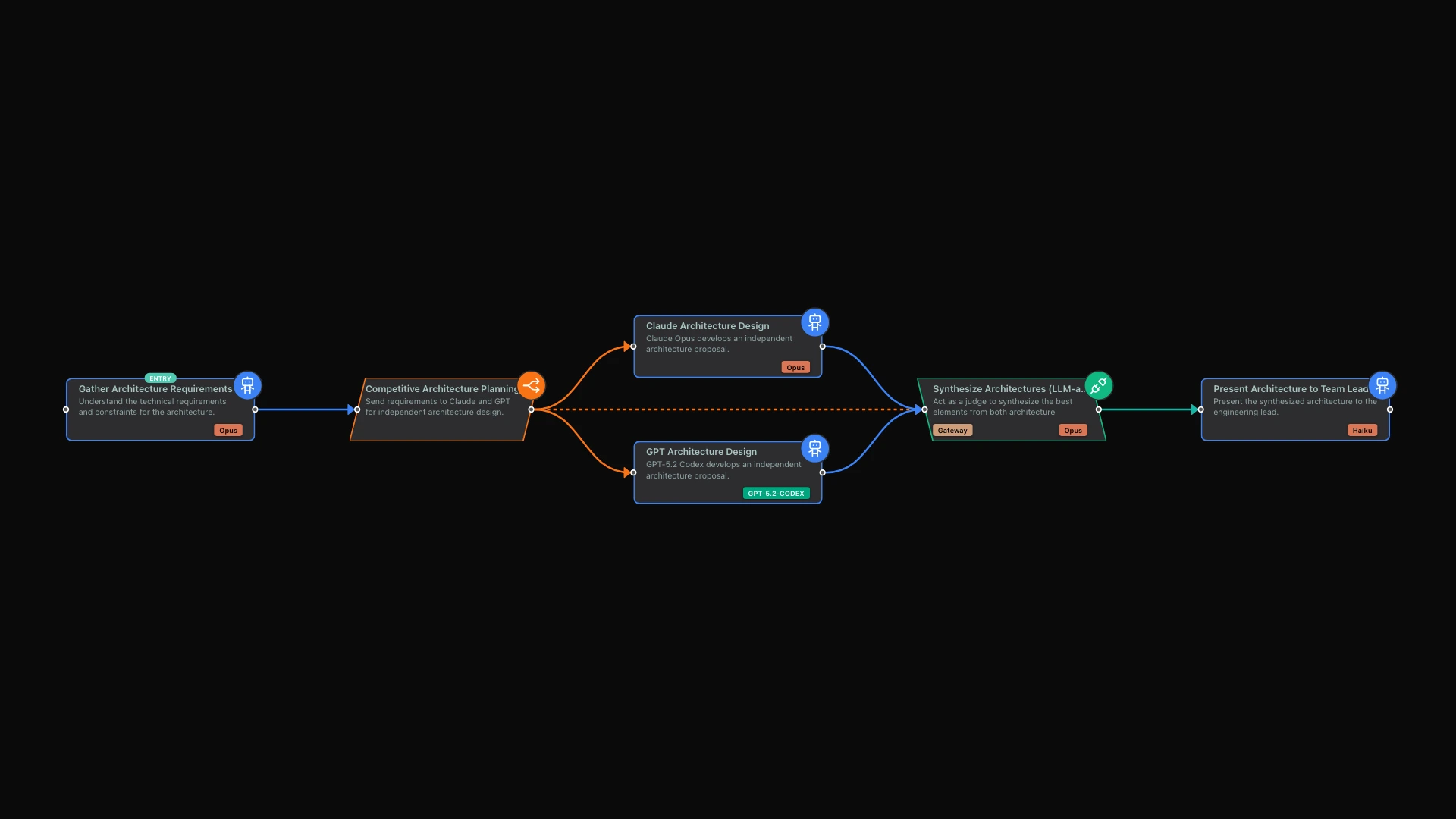
Using limerIQ's visual workflow editor, you design a competitive architecture planning process that feels natural and produces superior results.
Phase 1: Requirements Gathering
The workflow begins with a conversation that captures your architecture requirements comprehensively. Through an interactive dialogue, the system helps you articulate:
- Core functional and non-functional requirements
- Technology constraints and preferences
- Integration points with existing systems
- Success criteria and quality attributes
This initial phase ensures both competing architects work from identical, well-defined requirements. Consistency here guarantees a fair comparison later.
Phase 2: Parallel Architecture Design
The workflow then distributes your requirements to two independent AI architects. Each works in complete isolation, unaware the other exists.
One architect might be Claude, bringing strengths in clear communication, thoughtful planning, and comprehensive documentation. The other might be GPT, offering deep architectural reasoning and detailed implementation perspectives.
Both architects address the same concerns: system overview, technology choices with rationale, scalability strategies, security architecture, and implementation roadmap. But they approach the challenge from different angles, with different intuitions about what matters most.
Phase 3: Expert Synthesis
The integration phase is where the magic happens. A synthesis agent receives both proposals and creates something new - not by picking a winner, but by combining the strongest elements from each.
The synthesis follows a structured process:
- Identify consensus decisions - When both architects made the same choice, that becomes the foundation with high confidence
- Evaluate divergences - Understand why the approaches differed and what each perspective offers
- Capture unique strengths - Extract insights that one architect caught but the other missed
- Resolve conflicts - Make principled decisions with documented rationale
- Consolidate risks - Merge risk analyses from both perspectives into a comprehensive view
The output is a single architecture document that reflects the combined wisdom of both models - genuinely superior to what either would produce alone.
Why Model Diversity Matters
Different AI providers have genuinely different strengths:
| Provider | Notable Strengths |
|---|---|
| Claude | User communication, systematic planning, comprehensive documentation, safety considerations |
| GPT | Deep architectural reasoning, complex coding patterns, implementation detail, edge case handling |
When designing an event processing system:
- Claude might emphasize graceful degradation, clear interfaces, operational concerns, and human-readable documentation
- GPT might focus on algorithmic efficiency, implementation patterns, edge case handling, and performance optimization
Neither perspective is complete alone. Together, they cover more ground than any single model could.
Real-World Benefits
Engineering leads using competitive planning report several concrete advantages:
Faster Design Reviews
Traditional architecture reviews involve multiple human architects, scheduling conflicts, and lengthy discussions. Competitive planning produces a pre-synthesized design with documented trade-offs in minutes. Human review can focus on validation and strategic decisions rather than generation and comparison.
Higher Confidence Decisions
When two independent models reach the same conclusion, you can proceed with confidence. When they diverge, you know exactly where to focus human attention. The synthesis document explicitly flags consensus items versus resolved conflicts, making review efficient.
Better Documentation
The synthesis step produces documentation that explains not just what was decided, but why alternatives were rejected. This institutional knowledge is captured automatically, not lost in meeting notes or forgotten after the design review.
Reduced Vendor Lock-in
By using multiple AI providers in your workflows, you maintain optionality. If one provider changes pricing or capabilities, your processes adapt. You are not dependent on any single model for critical decisions.
When to Use Competitive Planning
Competitive planning is most valuable for high-stakes decisions where the cost of blind spots is significant:
| Scenario | Why Competitive Helps |
|---|---|
| High-stakes architecture decisions | Multiple perspectives reduce risk of costly blind spots |
| Novel problem domains | Different training data surfaces different patterns and approaches |
| Trade-off heavy decisions | Divergence reveals trade-offs you might otherwise miss |
| Documentation requirements | Synthesis produces detailed rationale automatically |
For routine decisions with clear best practices, a single model is sufficient. Competitive planning adds value when the problem space is complex enough that multiple valid approaches exist and getting it wrong carries significant consequences.
The Synthesis Difference
The synthesis approach is fundamentally different from simply getting two opinions and picking one. Traditional comparison asks: "Which is better?" Synthesis asks: "What can we learn from both?"
The result is knowledge creation, not just selection. You end up with an architecture that:
- Incorporates the strongest elements from each perspective
- Documents why certain approaches were preferred
- Acknowledges trade-offs explicitly
- Provides rationale that future teams can reference
This is research synthesis applied to architecture - creating understanding that did not exist before.
Getting Started
To try competitive architecture planning with limerIQ:
- Open the visual workflow editor and select the competitive planning template
- Describe your architecture challenge through the interactive requirements gathering
- Answer clarifying questions to establish constraints and success criteria
- Monitor parallel execution as both models work simultaneously
- Review the synthesized architecture and the documented reasoning
The workflow handles distribution, isolation, and synthesis automatically. You focus on validating the result and making final strategic decisions with the confidence that comes from multiple independent perspectives.
Beyond Architecture
The competitive parallel pattern applies to any task where multiple perspectives improve outcomes:
- Code review - Different models catch different issues and bring different expertise
- Security analysis - Diverse threat modeling perspectives uncover more vulnerabilities
- Technical writing - Multiple drafts synthesized into clearer, more complete content
- Testing strategy - Different approaches to coverage reveal gaps
Any time you would benefit from "getting a second opinion," competitive parallel execution delivers it systematically.
The Engineering Lead as Orchestrator
Modern engineering leadership is not about having all the answers. It is about structuring processes that produce better answers than any individual could alone.
Competitive planning embodies this principle:
- Define the problem clearly with structured requirements
- Distribute the thinking to multiple AI perspectives
- Synthesize the results into a coherent recommendation
- Validate and decide with human judgment on the final output
You are not replacing human architecture expertise. You are augmenting it with AI diversity that no human team could match for speed and breadth.
Your next architecture decision does not have to come from a single perspective. With competitive planning, it can benefit from the best of multiple AI minds.