
Cross-Team Coordination: Managing Multi-Team Projects with AI Orchestration
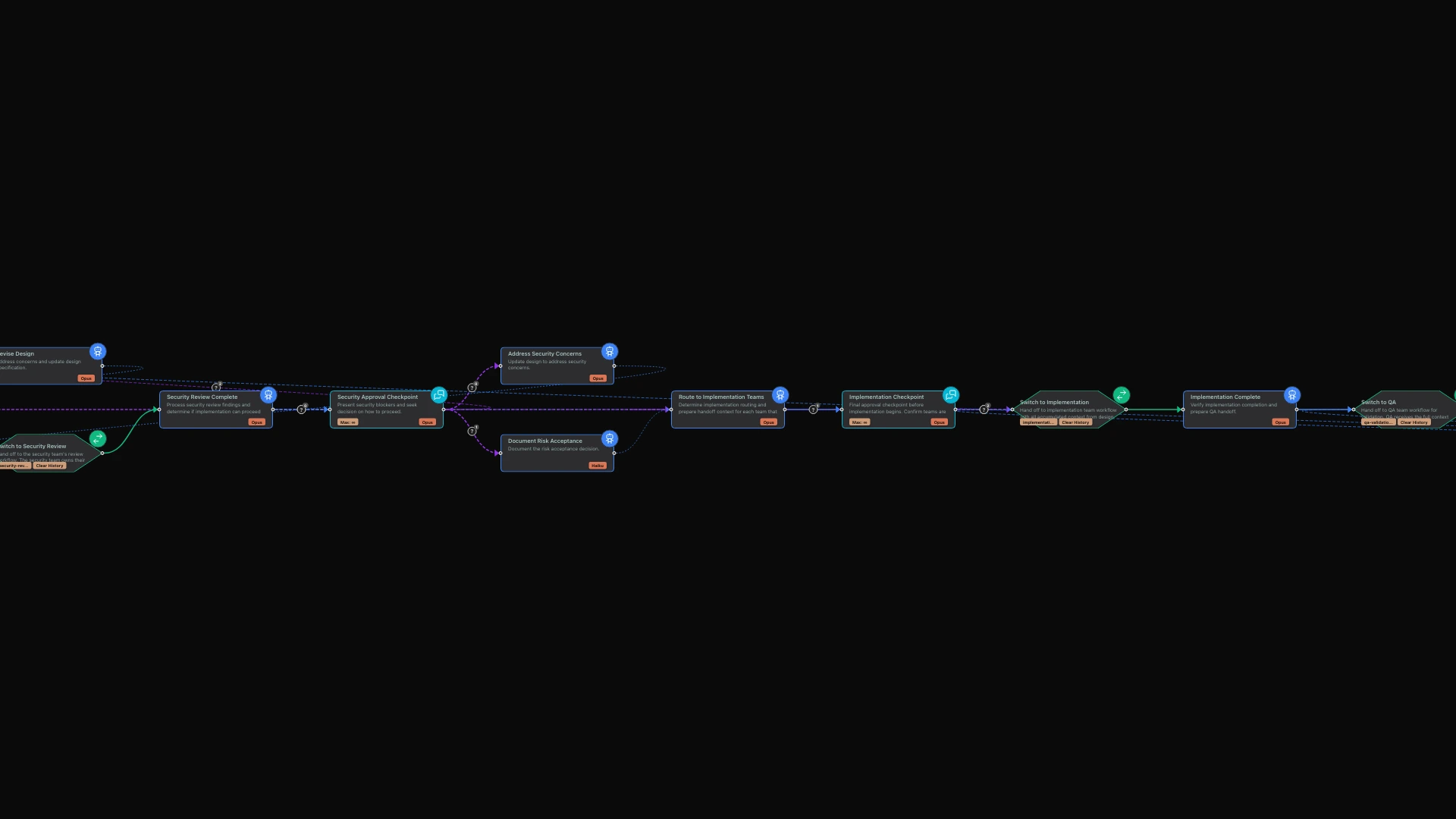
A comprehensive workflow that orchestrates feature development across multiple teams (Design, Security, Implementation, QA) with built-in checkpoints and context preservation. Demonstrates advanced li
Target Audience: Enterprise Architects, Staff Engineers, Technical Leaders
The Multi-Team Coordination Problem
Large organizations rarely build software within a single team. A typical enterprise project involves multiple specialized teams: frontend, backend, data, infrastructure, security, and QA. Each team has its own processes, tools, and review cycles.
The coordination overhead between these teams often dwarfs the actual development work. Handoffs get lost in Slack threads. Context evaporates between meetings. Teams block each other waiting for approvals or deliverables. The project plan exists in one system, the implementation in another, and the coordination in people's heads.
Traditional solutions rely on heavyweight project management tools or synchronous meetings. Neither scales well. The project manager becomes a bottleneck. Meetings consume the calendar. Documentation drifts from reality.
Structured Handoffs Between Teams
limerIQ addresses this challenge by enabling explicit, context-preserving handoffs between teams through its workflow orchestration capabilities. Each team owns their workflow, but handoffs carry full context forward automatically.
The key insight is that multi-team coordination is fundamentally a state machine. Work progresses through well-defined phases with clear entry and exit criteria. What makes coordination difficult is not the state machine itself but the loss of context at each transition.
When work moves from the design team to the security team, the security team needs specific information: the feature specification, the API contracts, the data models, the risk assessment. In traditional processes, this information gets summarized in a handoff meeting, documented in a ticket, and then re-discovered through questions and clarifications.
With limerIQ, the handoff is structured and complete. The workflow designer specifies exactly what context travels with the work. The receiving team's workflow can access this context immediately without parsing meeting notes or requesting clarification.
Checkpoint Steps: Team Sync Points
Multi-team projects need synchronization points where work from multiple teams converges. These checkpoint steps serve as explicit approval gates where stakeholders review accumulated work before proceeding.
Consider an architecture approval checkpoint. Work has arrived from multiple directions: the design team has proposed components, the security team has completed their assessment, the infrastructure team has documented requirements. The checkpoint presents all of this information to stakeholders in a unified view.
The experience is conversational. The AI presents the accumulated work, highlighting key decisions and potential concerns. Stakeholders ask questions, request clarifications, and eventually provide an explicit decision: approved, approved with conditions, or rejected.
Unlike calendar meetings, these checkpoints are asynchronous. Teams complete their work, the checkpoint captures the state, and approval can happen when stakeholders are available. The workflow pauses until the checkpoint is satisfied, ensuring nothing proceeds without appropriate sign-off.
Context Preservation Patterns
The most common failure mode in multi-team coordination is context loss. Information shared in one meeting fails to reach the next team. Decisions made early in the project are forgotten or contradicted later.
limerIQ addresses this through explicit context preservation at every handoff. Context travels in three categories:
Project-level context remains constant throughout the project: the project identifier, the overall goal, the constraints that apply everywhere. This context is established once and referenced throughout.
Phase-specific context accumulates as the project progresses: the discovery summary, the architecture decisions, the security requirements. Each phase adds to this accumulated context, creating a growing body of shared understanding.
Handoff-specific context is tailored to what the receiving team needs: the implementation specification, the test requirements, the API contracts. This focused context ensures teams receive exactly the information relevant to their work without information overload.
This pattern creates a structured handoff packet that travels with the work. Each team receives exactly the context they need, and that context is machine-readable and immediately actionable.
Multi-Team Orchestration Architecture
For complex multi-team projects, the recommended architecture uses a master orchestrator that coordinates team-specific workflows.
The master orchestrator owns the overall project state machine. It understands which phases exist, which teams are responsible for each phase, what the dependencies are between phases, and when the project is complete.
Team workflows own the work specific to each team. The frontend team's workflow handles frontend concerns. The security team's workflow handles security review. Each team can optimize their workflow for their specific processes without affecting other teams.
Handoff workflows provide standardized transitions between teams. When work moves from design to security, a handoff workflow ensures the context is properly packaged, the receiving team is notified, and the transition is logged.
Integration points are checkpoints where work from multiple teams converges. These are the moments when stakeholders review accumulated progress and make decisions about proceeding.
The master orchestrator does not implement any team's specific work. It manages transitions and ensures context flows correctly. This separation of concerns means teams can evolve their workflows independently while maintaining coordination at the project level.
Enterprise Integration Considerations
Multi-team workflows in enterprise environments must integrate with existing systems, and limerIQ supports these integrations naturally.
Audit Trail: Every workflow transition is logged with full context. This creates an auditable record of who did what, when, and what information they had when they did it.
Permission Boundaries: Different teams can operate with different permission levels. The security team's workflow might have access to sensitive configurations that the frontend team's workflow does not. These boundaries are enforced consistently.
Notification Integration: Workflow transitions can trigger notifications to team channels, create tickets in project management systems, or update dashboards. Teams learn about incoming work through their normal channels.
Rollback Support: If a downstream workflow fails, the master orchestrator can route to recovery workflows without losing the accumulated context. The work invested in earlier phases is preserved.
The User Experience
For teams using limerIQ for cross-team coordination, the experience is one of clarity and confidence.
When a team receives work, they know exactly what they are supposed to do. The context is complete. The expectations are clear. There is no ambiguity about what previous teams decided or what subsequent teams need.
When a team completes work, they know it will reach the right people with the right information. The handoff is automatic and complete. There is no need to write summary documents or schedule handoff meetings.
When stakeholders review progress at checkpoints, they see the complete picture. All relevant work from all contributing teams is presented together. Decisions are informed by full context rather than partial summaries.
And when questions arise, the answers are available. The context that informed each decision is preserved and searchable. Six months into a project, you can trace exactly why a particular architectural choice was made and what information was available at the time.
Avoiding Common Pitfalls
Over-Orchestration: Not every interaction needs a formal workflow handoff. Use structured handoffs for significant phase transitions, not routine communication. If teams can coordinate via shared documentation or chat, that is often simpler.
Context Bloat: Pass only the context the receiving team needs. Do not dump the entire project history into every handoff. Each transition should be purposeful and focused.
Missing Fallback Paths: What happens when a downstream workflow fails? Define explicit recovery paths in your master orchestrator. Unhandled failures should not leave work stranded.
Implicit Dependencies: Make all team dependencies explicit in the workflow structure. If Team B cannot start until Team A completes something, that dependency should be visible and enforced. Implicit dependencies create confusion and delays.
The ROI of Structured Coordination
Organizations that adopt structured cross-team coordination typically see significant improvements in project delivery.
Handoff time decreases dramatically because context travels automatically. Teams no longer wait for handoff meetings or chase down missing information.
Rework decreases because misunderstandings are caught early. When context is explicit and complete, downstream teams rarely discover that they built the wrong thing.
Visibility improves because progress is captured in the workflow state. Stakeholders can see exactly where work stands without convening status meetings.
Audit capability improves because every transition is logged. When questions arise about why something was done a certain way, the answers are available.
Conclusion
Multi-team coordination in enterprise projects fails because context evaporates at handoff boundaries. Traditional solutions add process overhead without solving the fundamental information flow problem.
limerIQ's orchestration capabilities address this by making handoffs explicit, typed, and context-preserving. Teams own their workflows. The master orchestrator manages transitions. Context flows automatically through the project lifecycle.
The result is coordination without meetings, handoffs without context loss, and visibility without heavyweight project management overhead.
Your multi-team projects can run with the clarity and efficiency of single-team projects, because the coordination that used to require heroic effort now happens automatically.
Next Steps:
- Explore the cross-team coordination templates in the limerIQ marketplace
- Identify the natural phase boundaries in your current projects
- Define the context that should flow between each phase
Related Articles: