
Migrating Legacy Systems: A Systematic Approach with AI Orchestration
A comprehensive, phased migration workflow for transforming legacy systems into modern architectures. Combines exploration, competitive planning with multiple AI models, and sprint-based execution wit
Target Audience: Enterprise Architects, Staff Engineers, Technical Leaders
The Legacy Migration Challenge
Every enterprise faces it eventually: a critical system built a decade ago, running technology that no longer receives security patches, maintained by developers who have long since moved on. The business depends on it daily, but the technical debt compounds with every passing quarter.
Legacy migration is not just a technical challenge. It is an organizational one. Failed migrations litter enterprise IT history, casualties of incomplete analysis, scope creep, and the sheer complexity of systems that have accumulated years of undocumented business logic.
The traditional approach relies on heroic efforts from senior engineers who hold institutional knowledge in their heads. When those engineers leave, the migration stalls. When requirements are missed, production breaks. When timelines slip, budgets evaporate.
What if migration could be systematic? What if the knowledge could be captured in documentation that persists? What if the process could be incremental, with human checkpoints at every critical decision point?
A Systematic Migration Framework
limerIQ addresses legacy migration through a structured workflow that enforces discipline at every phase. Through the visual workflow editor, organizations can design migration processes that capture institutional knowledge, enforce thoroughness, and create persistent documentation.
Phase 1: Intake and Scoping
The migration begins with a guided conversation that captures everything the team knows about the legacy system and what they hope to achieve. The AI asks structured questions: What are the migration goals? What constraints exist (timeline, budget, team capacity)? What does success look like? Which approach fits best: full rewrite, strangler fig pattern, lift-and-shift, or a hybrid?
This intake conversation produces a formal scoping document that becomes the foundation for everything that follows. The goals and constraints captured here inform every subsequent decision.
Phase 2: Legacy Exploration
Before touching any code, the system performs thorough analysis of the existing codebase. This exploration phase is deliberately separated from implementation to prevent the common failure mode of migrating before understanding.
The exploration produces four critical documents:
A Legacy Analysis document captures the architecture overview, component inventory, and technology stack. It answers fundamental questions: What does this system actually do? How is it structured? What technologies does it depend on?
A Dependency Map documents internal dependencies between components, external services the system connects to, and data ownership patterns. This map becomes essential when determining the order of migration phases.
A Risk Register catalogs risks by type (technical, business, operational, compliance) with likelihood, impact, and mitigation strategies for each. Migration without risk awareness is migration without a safety net.
A Migration Boundaries document identifies natural seams in the codebase where incremental migration phases can be defined. Not every boundary is obvious from outside the code.
These documents persist across sessions and team members. When a new architect joins the project six months in, they can read the exploration documentation rather than rediscovering everything from scratch. The knowledge that once lived only in experienced engineers' heads now lives in searchable, shareable documents.
Phase 3: Competitive Planning
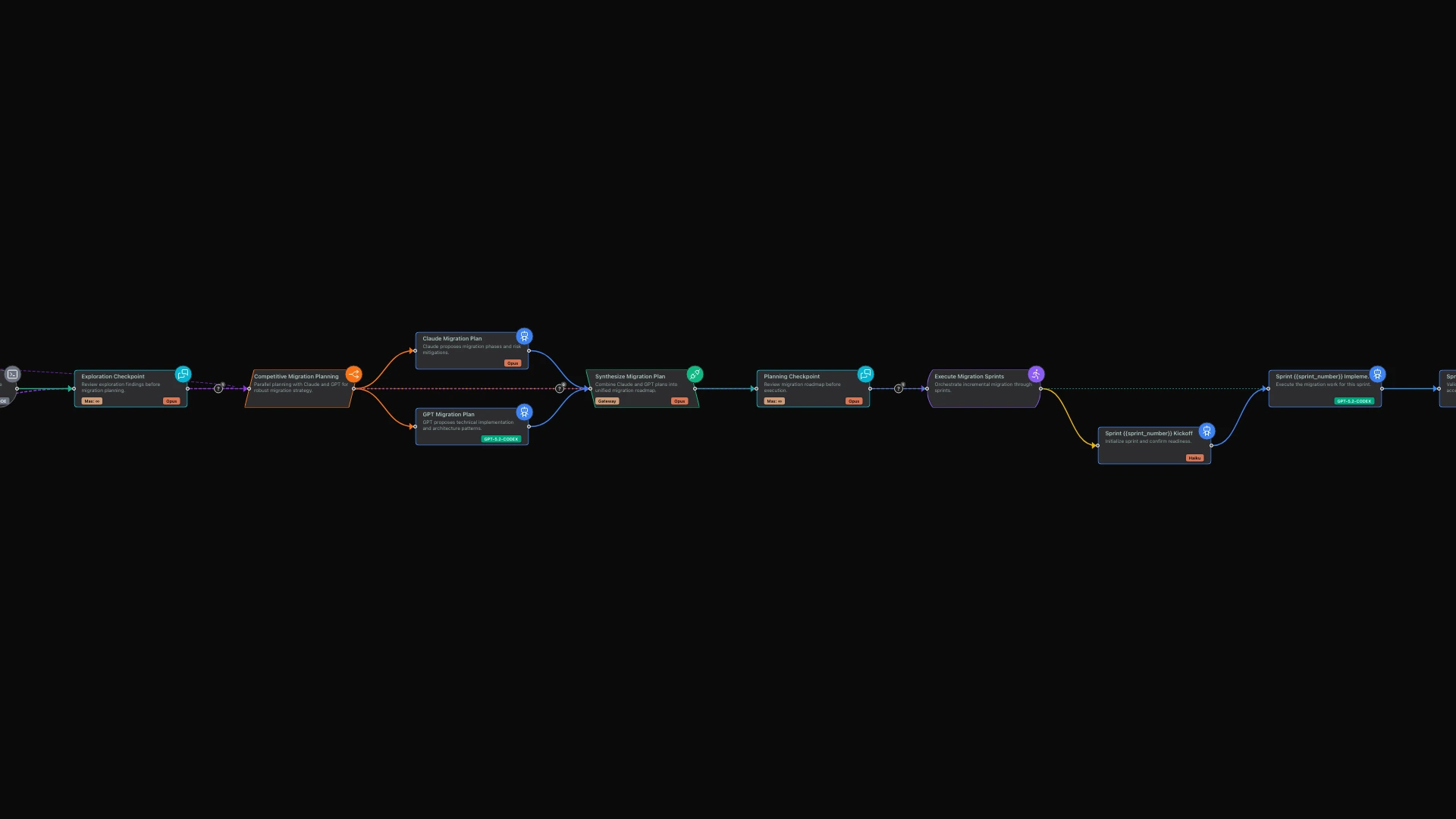
Single-perspective planning has blind spots. The workflow uses competitive parallel planning to produce more robust migration strategies.
Multiple AI models analyze the same problem independently. Claude excels at user experience considerations and communication clarity. GPT excels at deep architectural analysis and technical rigor. By running both independently and synthesizing the results, the workflow captures complementary perspectives: user-focused phase breakdown with clear success criteria, technical architecture patterns and dependency resolution order, risk mitigations from multiple viewpoints.
The synthesis step resolves conflicts and produces a unified Migration Roadmap that incorporates the best elements from both models. Disagreements between models highlight areas that warrant additional human review.
Phase 4: Sprint-Based Execution
Large migrations fail when they try to do everything at once. The workflow breaks execution into manageable sprints, each with its own objectives, acceptance criteria, and rollback strategy.
Each sprint follows a structured cycle. The kickoff reviews objectives, identifies which components will be migrated, and confirms acceptance criteria. Implementation executes the migration work for this phase. Validation verifies against acceptance criteria and tests backward compatibility. A human review checkpoint allows the architect to approve continuation or adjust the plan before the next sprint begins.
This incremental approach prevents the "runaway migration" failure mode. If Sprint 2 reveals unexpected complexity, the architect can pause, replan, and adjust rather than discovering the problem three sprints later when the damage is harder to undo.
Phase 5: Integration and Completion
The final phase validates the complete migration, documents lessons learned, and creates operational runbooks for the new architecture. A comprehensive completion document captures what was migrated, what changed from the original plan, and what operational considerations apply going forward.
This documentation becomes valuable for the next migration cycle, years later, when the system you are building today becomes the legacy system of tomorrow.
Documentation as Migration Memory
Traditional migrations rely on tribal knowledge. Engineers hold critical context in their heads. When they leave, the knowledge leaves with them.
limerIQ's documentation scaffolding transforms this dynamic. Every phase produces documentation automatically. Sprint logs capture implementation decisions and blockers. Test results provide validation evidence. Progress tracking shows cumulative migration status.
This documentation persists beyond the migration itself, providing institutional memory for future maintenance and eventual next-generation migrations. The knowledge that enabled this migration remains available for the engineers who will maintain the system for years to come.
Risk Management Built In
Every phase of the workflow considers risk explicitly.
The exploration phase produces a comprehensive Risk Register that categorizes technical, business, operational, and compliance risks with likelihood, impact, and mitigation strategies.
The planning phase ensures each sprint includes explicit risks and rollback strategies. The competitive planning process surfaces risks that single-model approaches miss.
The execution phase validates rollback readiness before proceeding. Human checkpoints allow risk-based decisions about continuing or pausing.
The completion phase validates cross-sprint compatibility and produces cleanup recommendations for legacy decommissioning.
The Human Experience
For the architects and engineers driving the migration, the experience is one of supported decision-making rather than unsupported heroism.
During intake, a guided conversation captures context that might otherwise be forgotten or assumed. During exploration, thorough analysis happens automatically, producing documents that would take weeks to create manually. During planning, multiple perspectives surface considerations that any single planner might miss.
At every critical juncture, human checkpoints ensure that people remain in control. The AI presents options, analysis, and recommendations. Humans make decisions. Those decisions are documented and inform subsequent phases.
This is not automation replacing human judgment. It is automation amplifying human judgment by ensuring that judgment is applied at the right moments, with the right information, in a systematic process that can be audited, reproduced, and improved.
Why Orchestration Matters for Migration
Legacy migration is too important to leave to ad-hoc processes. The stakes are high: business continuity, data integrity, team productivity. The complexity is substantial: years of accumulated business logic, undocumented dependencies, organizational knowledge gaps.
AI orchestration provides the structure that migrations need. Systematic exploration prevents blind migrations. Competitive planning produces robust strategies. Incremental execution limits blast radius. Human checkpoints ensure strategic control. Documentation scaffolding preserves knowledge.
Your next legacy migration can be different. It can be systematic, documented, and incremental. It can preserve knowledge and enable course correction. It can succeed where previous migrations failed.
Next Steps:
- Explore the legacy migration workflow templates in the limerIQ marketplace
- Review your legacy systems for migration candidates
- Read Multi-Provider AI Strategy for model selection guidance
Related Articles: