
Enterprise Governance for AI Development: Audit Trails and Approval Workflows
A production-ready workflow that implements governed change request processes with approval gates, comprehensive compliance checks, and complete audit trails. Designed for regulated enterprises that r
Target Audience: Enterprise Architect / Staff Engineer
Reading Time: 8 minutes
When enterprises evaluate AI development tools, the conversation inevitably turns to governance. How do we maintain audit trails? Where are the approval gates? How do we satisfy our compliance team?
These questions often feel at odds with the promise of AI acceleration. Traditional AI coding assistants operate in a black box: you prompt, you get code, and the trail between intent and implementation vanishes into the ether. For regulated industries, that is simply unacceptable.
limerIQ takes a different approach. Rather than treating governance as a constraint to work around, we have built it into the orchestration layer. The result is AI-powered development that satisfies even the most demanding compliance requirements while maintaining the productivity gains you expect from modern tooling.
The Governance Challenge
Enterprise software development operates under constraints that solo developers never face:
- Audit Requirements: Every change must have a documented chain of custody
- Approval Gates: Certain changes require explicit sign-off before proceeding
- Compliance Reviews: Security and regulatory checks cannot be optional
- Traceability: From requirement to implementation, every decision must be recorded
Traditional CI/CD pipelines handle some of this, but they operate after code is written. The AI development process, where code emerges from natural language prompts, creates a new gap in the audit trail.
How limerIQ Addresses Enterprise Governance
limerIQ provides three key mechanisms for enterprise governance: interactive approval steps, documentation scaffolding, and the permission system.
Interactive Approval Steps: Human-in-the-Loop Gates
Interactive steps in limerIQ create explicit pause points where human judgment is required. Unlike simple yes/no prompts, these are full conversation steps where the AI presents relevant context and the human provides documented decisions.
When you design a workflow in the visual editor, you can insert approval gates at any point. These gates present all relevant information to the reviewer: the change request details, risk classification, compliance requirements, and any analysis performed by previous steps.
The approval experience is conversational. The AI guides the approver through the decision, asking for explicit approval or rejection, any conditions or requirements, the rationale for the decision, and any concerns that should be documented.
Every response is captured and logged. The workflow cannot proceed until the approver explicitly signals completion. There is no way to accidentally bypass a required approval.
Documentation Scaffolding: Automatic Audit Trails
Documentation scaffolding is a workflow-level feature that ensures every execution produces structured documentation automatically. When enabled, limerIQ creates a timestamped execution record for each workflow run, maintains a chain of documentation showing how decisions led to outcomes, and preserves the context that informed each step.
For compliance-sensitive workflows, you can also specify required documentation. If a change request workflow must produce a formal change request document and an approval log, the workflow will not complete successfully unless those files exist. There is no path forward without the required documentation.
This approach transforms documentation from an afterthought into a natural byproduct of the development process. Teams do not need discipline to create audit trails because the audit trails create themselves.
Permission System: Enterprise-Grade Security
limerIQ's permission system provides enterprise-grade control over what AI agents can do. The system works through multiple layers:
At the provider level, each AI provider (Claude, GPT, Gemini) operates under constraints that you define. You control which directories the AI can access, which tools it can use, and whether any action requires human approval.
For automated workflows running without direct supervision, you can enforce that any unapproved action is automatically denied. This prevents autonomous AI operations from performing actions outside approved boundaries, even when no human is present to approve.
Every approval decision is logged for audit purposes. Your compliance team can review exactly what actions were requested, what was approved or denied, and by whom.
A Complete Governed Workflow
Consider how a governed change request process works in practice with limerIQ.
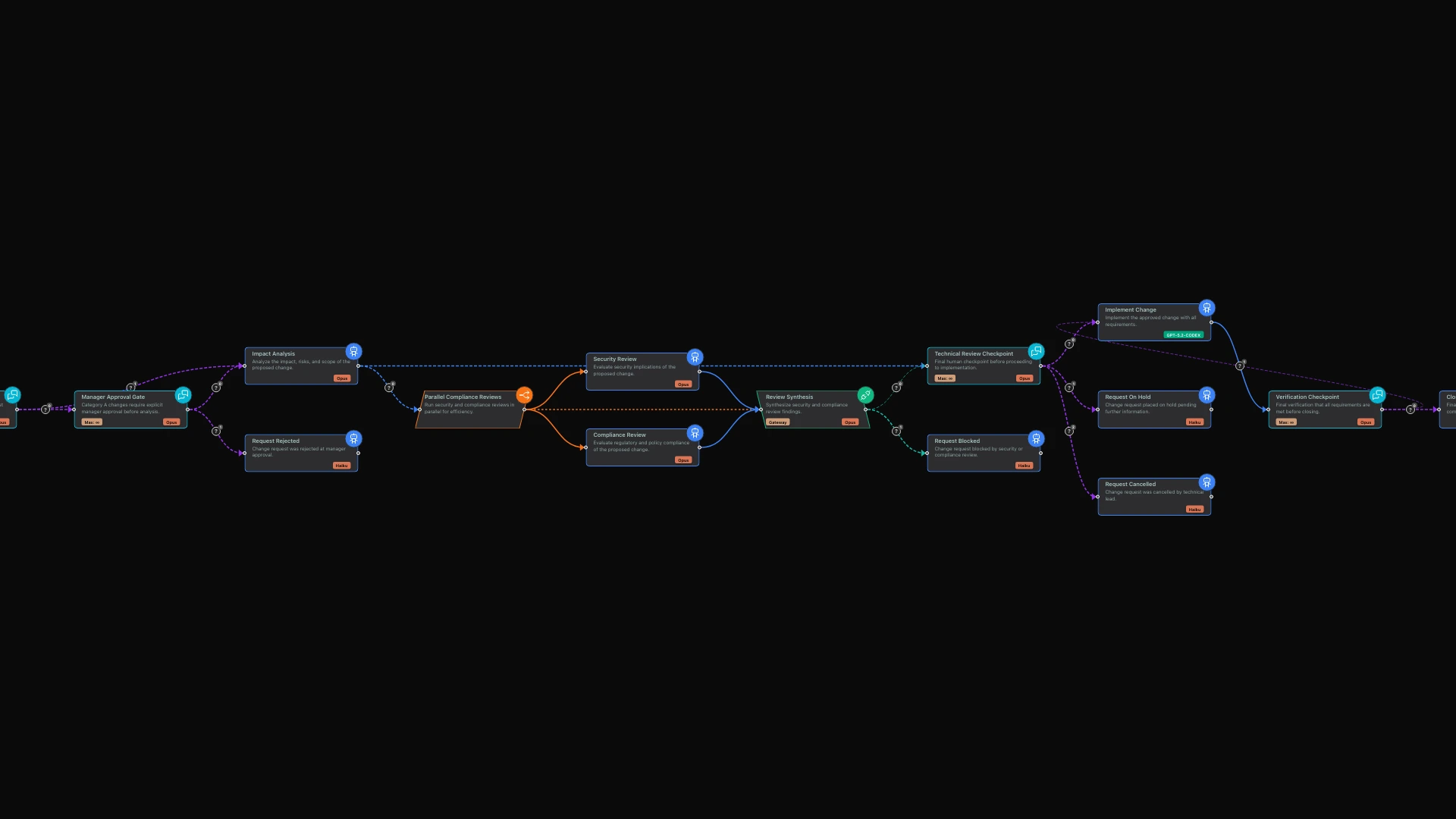
First, the intake phase captures the change request through a guided conversation. The AI asks structured questions to understand what is being changed, why, what systems are affected, and what risks exist. The conversation naturally captures all the metadata required for proper classification.
Next, the system evaluates risk. Category A changes (infrastructure, security, database schema) require manager approval before proceeding. Category B and C changes flow directly to analysis. This risk-based routing mirrors how enterprise change management processes typically work.
For changes requiring manager approval, the workflow presents a complete summary to the approver: the request details, the risk classification, and any preliminary analysis. The manager reviews, asks clarifying questions if needed, and provides a documented decision with rationale.
After approval, the workflow performs impact analysis, examining scope, risks, testing requirements, and creating a rollback plan. This analysis is thorough but does not require human attention at every moment.
Security and compliance reviews run in parallel, each producing documented findings. Rather than sequential reviews that slow everything down, these run simultaneously and their findings merge at the end. The integration step determines the overall status: if either review is blocked, the overall status is blocked; if both approve, the change proceeds; otherwise, it proceeds with conditions.
A final technical review checkpoint presents all findings to the technical stakeholders. They see the original request, the impact analysis, the security findings, the compliance findings, and the overall assessment. With all information in hand, they make an informed decision about proceeding to implementation.
Only after all approvals are in place does implementation begin. After implementation, a verification checkpoint confirms that all requirements are met. Finally, the change request closes with a complete audit package.
Every step produces documentation. Every approval is logged. Every decision has a recorded rationale.
Integrating with Existing Enterprise Systems
limerIQ workflows can integrate with your existing governance infrastructure. Approval requests can trigger ticket creation in Jira or ServiceNow. Notifications can post to Slack or Teams channels. Completed workflows can automatically create pull requests with approval metadata attached. Audit logs can export in whatever format your compliance systems require.
The workflow definition itself becomes a source of truth that can be version-controlled alongside your infrastructure code. When auditors ask how changes are governed, you can show them the workflow.
The ROI of Built-In Governance
Traditional governance adds friction. Review meetings fill calendars. Approval processes create bottlenecks. Documentation requirements slow everything down.
With limerIQ, governance becomes a feature rather than a burden. Approvals happen asynchronously when stakeholders are available, not in scheduled meetings. Documentation generates automatically as a byproduct of the process. Context travels with the work, eliminating the need to recreate information at each handoff.
Teams that adopt limerIQ's governed workflows typically see approval cycle times decrease by 60% or more. Not because approvals are being skipped, but because the right information reaches the right people at the right time, without manual coordination.
Conclusion
Enterprise governance and AI acceleration are not mutually exclusive. With limerIQ:
- Every AI-assisted change has a documented audit trail
- Human approval gates are built into the workflow, not bolted on
- Compliance reviews happen automatically as part of the process
- The permission system provides defense in depth against unauthorized actions
This is not governance as an afterthought. This is governance as a first-class feature of the development process.
For enterprises evaluating AI development tools, the question is not whether AI can accelerate development. The question is whether it can do so while meeting your compliance requirements. With limerIQ, the answer is yes.
Try it yourself: Explore the governance workflow templates in the limerIQ marketplace.
Next in the series: Migrating Legacy Systems: A Systematic Approach with AI Orchestration
Explore more: limerIQ Documentation | Workflow Marketplace