
From Ticket to PR: Automating the Developer Workflow
For Engineering Team Leads looking to eliminate handoff friction and ensure consistent delivery
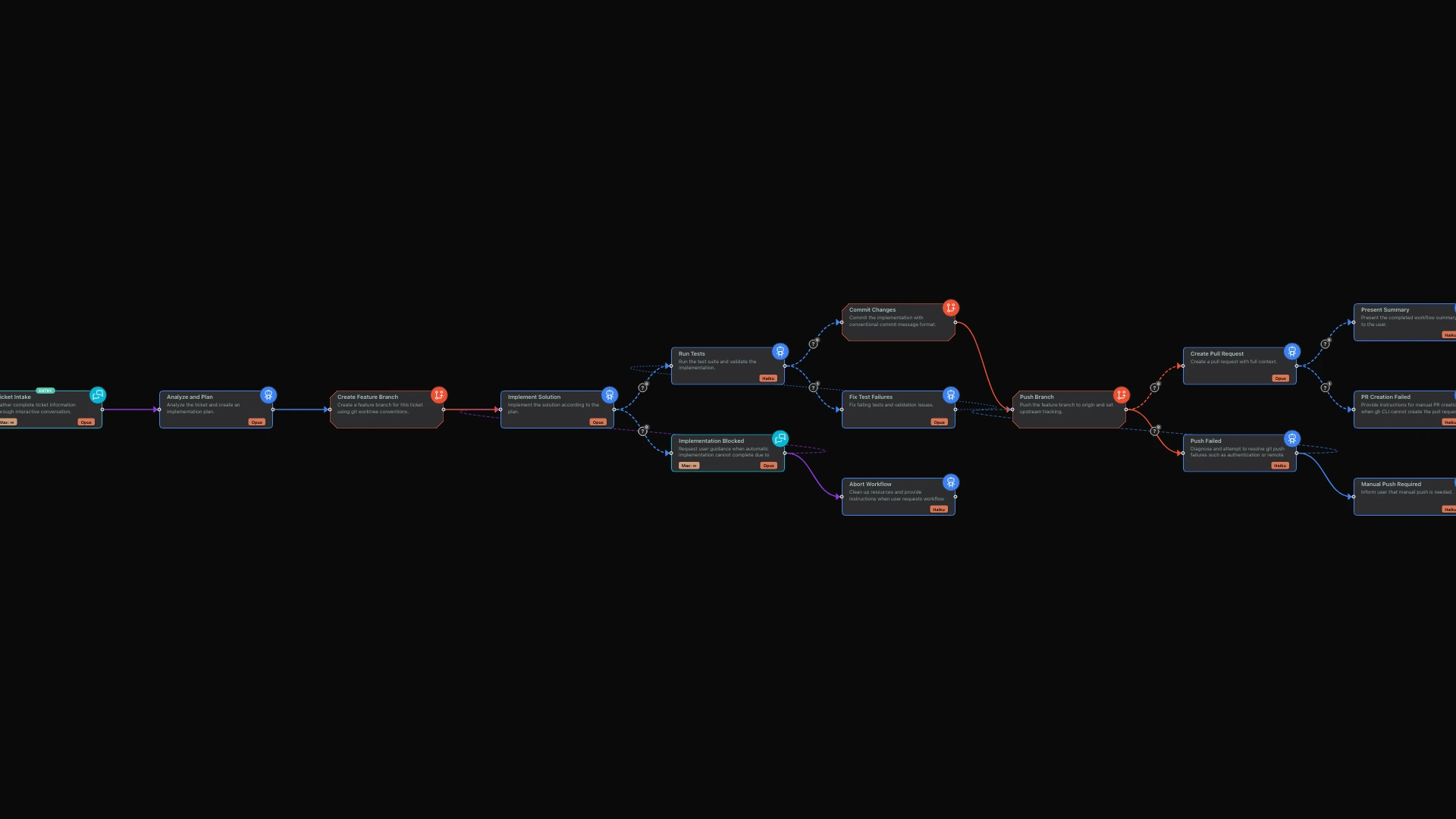
Every engineering team has the same workflow: ticket arrives, developer picks it up, code gets written, tests run, PR opens, review happens, code merges. Simple in theory. Chaotic in practice.
The friction is not in any single step. It is in the transitions. A developer reads a vague ticket and interprets it one way. They write code, but forget to update the related tests. They open a PR with a cryptic description. The reviewer asks clarifying questions. The original ticket context has faded. Days pass. The cycle repeats.
What if you could encode your entire ticket-to-PR workflow into a single, repeatable process that handles discovery, implementation, testing, and PR creation with consistent quality every time?
The Hidden Cost of Manual Handoffs
Consider what happens when a developer picks up a ticket:
Discovery Phase - They read the ticket, check related code, maybe ask clarifying questions. This context-gathering can take 30 minutes to several hours depending on complexity.
Implementation Phase - They write code, hopefully following team conventions. Maybe they create a feature branch. Maybe they commit directly to a dev branch. Consistency varies.
Testing Phase - They run tests locally. Maybe all of them, maybe just the relevant ones. Quality depends on individual discipline.
PR Creation Phase - They write a PR description, link to the ticket, request reviewers. The quality of context provided varies wildly between developers.
Each handoff introduces variance. Each variance introduces risk. Over time, these small inefficiencies compound into significant velocity drags.
limerIQ's ticket-to-PR workflow encodes your team's best practices into an automated pipeline that runs the same way every time.
The Automated Developer Workflow
Using limerIQ's visual workflow editor, you design a ticket-to-PR process that handles the entire journey from initial ticket to mergeable pull request. The experience transforms chaotic handoffs into a smooth, predictable pipeline.
The journey begins with intelligent discovery. Rather than relying on incomplete ticket descriptions, the workflow engages in a conversation to gather all necessary context. What exactly needs to be built? What is the expected behavior? Which files or modules are likely involved? Are there specific acceptance criteria or test requirements?
This interactive intake asks clarifying questions when descriptions are vague. Ambiguity is resolved before any code is written, not discovered during code review.
Next comes analysis and planning. The system examines the ticket requirements in the context of your actual codebase. It identifies relevant files, understands the scope of changes needed, and plans an implementation approach consistent with your team's patterns.
Branch creation follows automatically. A feature branch is created with proper naming conventions - no more inconsistent branch names across your team. The branch name reflects the ticket and work being done, making it easy to track.
Implementation happens within your established patterns. Code is generated following your team's conventions, architecture patterns, and style guidelines. The work respects module boundaries and integrates properly with existing systems.
Validation gates ensure quality before any commit. The workflow runs your test suite and validates the changes meet your standards. If tests fail or quality checks do not pass, the workflow addresses the issues and re-validates rather than pushing broken code.
Changes are committed with proper messages. Commit messages follow your team's conventions and include appropriate context linking back to the original ticket.
Finally, a complete pull request is created. The PR includes a comprehensive description with the original ticket context, implementation notes, test results, and any relevant caveats. Reviewers get everything they need without chasing down information.
The Quality Gate Advantage
One of the most valuable aspects of the automated workflow is the validation gate before any code is committed.
In manual workflows, the testing phase is often where discipline breaks down. Developers under time pressure may skip running the full test suite. They may miss tests that need updating. They may assume their changes work without verification.
The automated workflow enforces testing consistently. Every change passes through validation. If tests fail, the system addresses the issues before proceeding. Broken code never makes it to a pull request.
This is not optional. This is how the workflow operates. The result is pull requests that are actually ready for review - not PRs that immediately fail CI and require additional work.
Handling Real-World Complexity
Real development has complications. The automated workflow handles common challenges gracefully:
Vague Tickets: The interactive discovery phase asks clarifying questions until requirements are clear. Rather than guessing at intent and getting it wrong, the workflow ensures understanding before implementation.
Test Failures: When tests fail, the workflow loops back to address the issues and re-validates. This cycle continues until the changes pass, ensuring quality rather than deferring problems.
Complex Changes: For larger changes, the planning phase can break work into smaller, incremental pieces with validation at each step. This reduces risk and makes review more manageable.
Missing Context: If the system cannot determine the correct approach with confidence, it requests human input through the interactive conversation rather than making assumptions that may be wrong.
The workflow handles the mechanical aspects while escalating decisions that require human judgment.
Why This Matters for Team Leads
As a team lead, you care about consistency and velocity. The ticket-to-PR workflow delivers both:
Consistency - Every ticket follows the same process. Branch naming, commit messages, PR descriptions, test coverage - all standardized automatically. No more variation based on who picked up the ticket or when they worked on it.
Velocity - Developers spend less time on process overhead. The workflow handles the mechanical work, freeing developers for the creative problem-solving that actually requires human judgment.
Quality - Validation gates catch issues early. No more PRs that break CI or lack test coverage. Problems are addressed before they become blockers.
Visibility - Every PR includes full context. Reviewers understand what changed and why without extra investigation. Review cycles become shorter and more focused.
Onboarding - New developers learn your process by using it. The workflow encodes institutional knowledge about how your team operates, teaching conventions through practice.
The Full Development Lifecycle
The complete workflow covers the entire software development lifecycle for a single ticket:
- Discovery - Interactive gathering of complete requirements
- Planning - Analysis of the ticket and approach within your codebase context
- Setup - Feature branch creation with proper naming
- Implementation - Code generation following team patterns
- Testing - Automated validation before commit
- Commit - Changes committed with conventional messages
- PR Creation - Full-context pull request opened automatically
- Summary - Developer presented with relevant links and next steps
Each step produces outputs that flow into the next, creating a seamless pipeline from ticket to mergeable PR.
The Compound Effect
One automated workflow might seem incremental. But consider the compound effect across your team:
- 10 developers
- 5 tickets per developer per week
- 30 minutes saved per ticket on process overhead
- 25 hours per week freed for actual development
That is more than three full developer-days per week returned to your team. Over a year, the impact is substantial.
More importantly, the consistency compounds too. Every ticket follows best practices. Every PR has full context. Every merge includes proper testing. The quality baseline rises without adding process burden.
You are not asking developers to follow more rules. You are automating the rules so they happen naturally.
Getting Started
To implement ticket-to-PR automation for your team:
- Open limerIQ's visual workflow editor and select the ticket-to-PR template
- Customize for your technology stack - Configure the implementation and testing phases for your specific tools
- Set your branch conventions - Define your branch naming pattern and commit message format
- Add team-specific validation - Include your linting rules, test coverage requirements, and style checks
- Run on a real ticket - Try the workflow on a small ticket to see it in action
- Iterate based on results - Refine the workflow based on what your team finds valuable
The workflow handles the process automation. Your developers handle the creative work that actually requires human insight.
The Strategic Vision
The ticket-to-PR workflow represents a fundamental shift in how development work gets done. Instead of relying on individual discipline and hoping for consistency, you encode your best practices into a system that enforces them automatically.
Every ticket gets the same thorough treatment. Every PR arrives ready for meaningful review. Every merge includes the quality gates your team values.
Your developers stop spending time on process mechanics and start spending time on the problems that actually require their expertise. That is the promise of workflow automation done right.
What's Next?
The ticket-to-PR workflow is one piece of a comprehensive engineering automation strategy. For parallel code review that multiplies your review capacity, see The Parallel Code Review: How limerIQ Eliminates Your Team's Review Bottleneck. For onboarding automation that gets new hires productive faster, explore Onboarding Engineers in Days, Not Months.
Ready to eliminate your workflow friction? Try limerIQ today and automate your first ticket-to-PR pipeline.