
Product Discovery That Writes Itself: Automated PRD and User Story Generation
Transform product ideas into comprehensive, production-ready documentation automatically. This workflow guides you through interactive discovery to capture requirements, then AI-generates a complete P
Target Audience: Product Managers, Founders, and anyone responsible for translating ideas into actionable documentation.
Every product manager knows the drill. You have a brilliant product idea, stakeholders are excited, and the development team is ready to build. But first, you need to write the PRD. Then the user stories. Then the acceptance tests. Hours pass. Days pass. The documentation debt piles up while the actual product waits.
What if that documentation could write itself?
The Documentation Tax
Product managers spend an estimated 40% of their time on documentation. That is not strategy. That is not customer discovery. That is not the work that actually moves products forward. It is the necessary but tedious translation layer between "what we want to build" and "what engineers can implement."
The traditional process looks like this:
- Stakeholder meeting to capture requirements (1-2 hours)
- Draft the PRD (4-8 hours)
- Write user stories (2-4 hours)
- Define acceptance criteria (2-3 hours)
- Review cycles with stakeholders (2-4 hours)
- Revisions based on feedback (2-4 hours)
For a modest feature, that is 13-25 hours of documentation work before a single line of code gets written. For larger initiatives, multiply accordingly.
Discovery Workflows: A Different Approach
limerIQ introduces discovery workflows that automate the documentation generation process while keeping you in control. Instead of manually drafting each artifact, you have a structured conversation about your product idea, and the system generates comprehensive documentation from that conversation.
Here is how it works in practice.
Phase 1: The Intake Conversation
The workflow begins with an interactive intake conversation. Rather than staring at a blank PRD template, you answer focused questions from an AI that understands product management:
- What is the product or feature idea?
- Who are the target users? What pain points does this solve?
- What does success look like? How will you measure it?
- What are the key constraints?
- What is in scope for the MVP? What is explicitly out of scope?
The AI acts as an experienced PM partner, probing for gaps and ambiguities. If your answer is vague, it asks follow-up questions. If you mention constraints without specifics, it drills down. The conversation typically takes 10-15 minutes.
Phase 2: Automatic PRD Generation
Once the intake is complete, the system generates a structured PRD. This is not a rough draft that needs heavy editing. It is a comprehensive document that includes:
- Executive Summary
- Product Vision
- Target Users and Personas
- Problem Statement
- Goals and Success Metrics
- Scope (MVP, future enhancements, non-goals)
- Numbered Functional Requirements (FR-001, FR-002, etc.)
- Non-Functional Requirements
- Risks and Mitigations
- Open Questions
Every requirement gets a trackable ID that flows through to user stories and acceptance tests, creating full traceability from vision to implementation.
Phase 3: User Stories with Acceptance Criteria
The workflow continues to generate user stories, automatically referencing the requirements from the PRD. Each story follows a consistent format:
US-001: User Registration
Priority: P0 (MVP)
Persona: New User
Story: As a new user, I want to create an account so that I can access the platform.
Requirements: FR-001, FR-002
Acceptance Criteria:
- Given I am on the registration page, when I submit valid credentials, then my account is created
- Given I am on the registration page, when I submit an existing email, then I see an error message
The stories are prioritized (P0 for MVP, P1 for soon, P2 for later) and cross-referenced to requirements. You get 10-20 stories covering your MVP scope, each with specific acceptance criteria that engineers can implement against.
Phase 4: Acceptance Tests
Finally, the workflow generates comprehensive acceptance tests that map back to user stories and requirements, creating a complete traceability matrix. Edge cases, error scenarios, and non-functional tests are included automatically.
This traceability is powerful. When a stakeholder asks "why does this feature exist?" you can trace from test to story to requirement to business goal. When an engineer asks "what should happen in this edge case?" the answer is already documented.
Phase 5: Review and Refine
The workflow does not just generate and disappear. An interactive review checkpoint lets you examine the generated documentation and request changes:
"Here is your PRD and user stories. Take a look and let me know if anything needs adjustment. Are there stories missing? Do the acceptance criteria capture your vision of success?"
If something is missing or needs adjustment, you provide feedback and the system applies revisions while maintaining consistency across all documents. Change a requirement in the PRD, and the related user stories and acceptance tests update accordingly.
The 40% Time Savings in Action
Let us compare timelines:
Traditional Approach (13-25 hours):
- Stakeholder meeting: 2 hours
- Draft PRD: 6 hours
- Write stories: 3 hours
- Define acceptance criteria: 3 hours
- Review cycles: 3 hours
- Revisions: 4 hours
Discovery Workflow (2-4 hours):
- Intake conversation: 15 minutes
- Review generated PRD: 30 minutes
- Review generated stories: 20 minutes
- Review acceptance tests: 20 minutes
- Provide revision feedback: 15 minutes
- Final review: 20 minutes
That is a 6-10x reduction in documentation time. More importantly, the time you do spend is on high-value review and refinement rather than blank-page writing.
The Visual Editor Experience
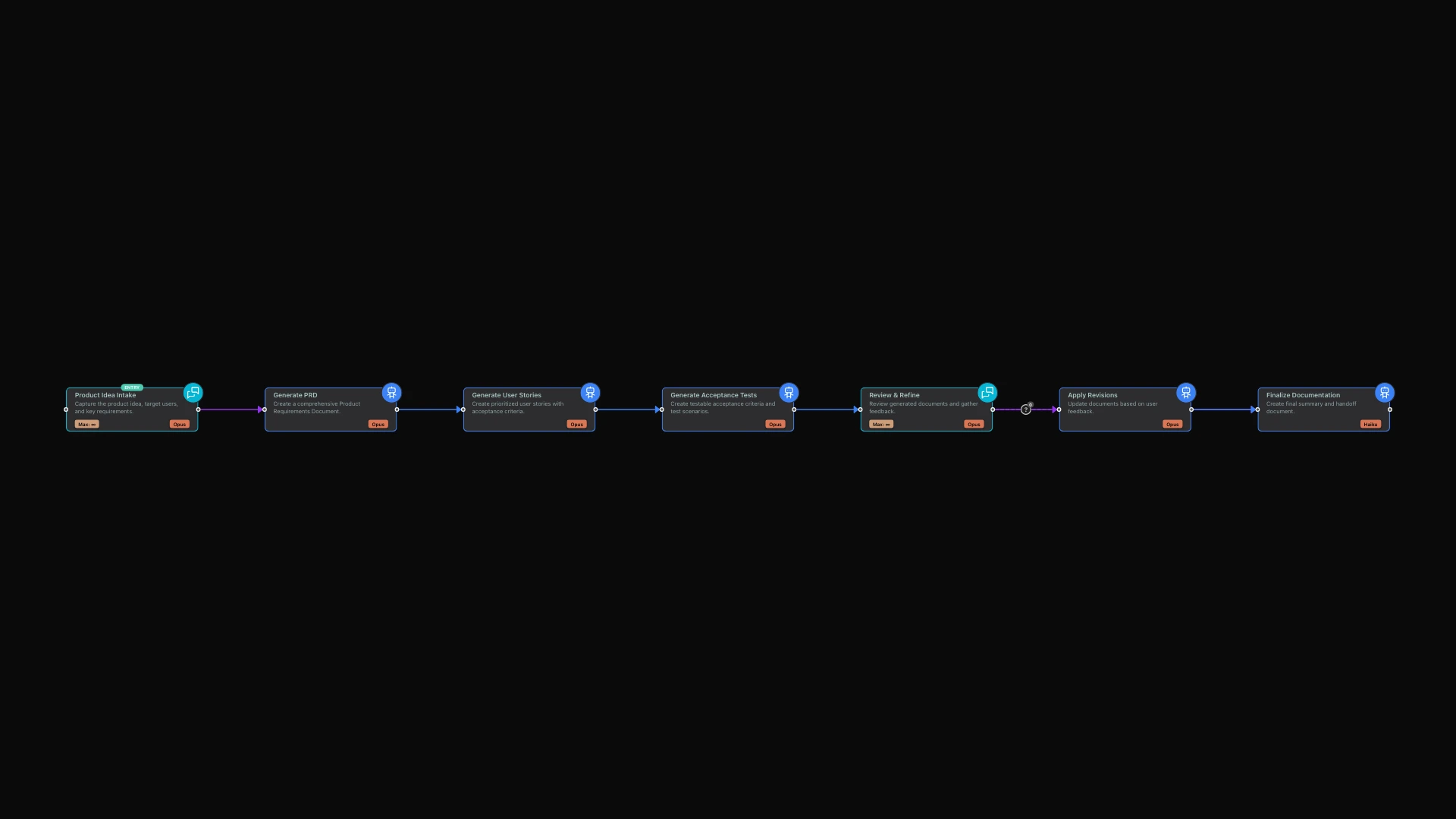
In limerIQ's visual workflow editor, you can see the entire discovery flow laid out as connected stages. The intake conversation feeds into PRD generation, which feeds into user story creation, which feeds into acceptance test generation, with a review checkpoint at the end.
This visibility serves multiple purposes. For individual PMs, it demystifies what happens between "I described my idea" and "I have complete documentation." For teams, it creates a shared understanding of the documentation process. For stakeholders, it provides confidence that the process is thorough and repeatable.
You can also customize the workflow to match your organization's documentation standards. If your PRD template includes sections not in the default, you can add them. If you use a different user story format, you can configure that. The workflow adapts to your process rather than forcing you into a rigid structure.
Key Benefits
Interactive conversations instead of blank pages. Starting from a conversation is psychologically easier and often produces better results than staring at an empty template.
Guaranteed outputs. The system ensures every step produces its required artifact. No more "I thought I saved that" or "I forgot to include acceptance criteria."
Product manager expertise built in. The AI understands product documentation conventions, appropriate terminology, standard formats, and the information that actually matters to product teams.
Consistent cross-references. Requirement IDs flow from PRD to user stories to acceptance tests. Traceability is automatic, not manual.
Beyond Documentation
The generated artifacts are not just documents. They are structured data that feeds into the next phase of product development. Use the PRD and user stories as input to limerIQ builder workflows that can generate implementation plans, technical designs, and even working code.
Product discovery that writes itself is not about removing PMs from the equation. It is about freeing you to do the strategic work that actually requires human judgment while automating the translation work that does not.
Ready to try it? Open the discovery workflow in limerIQ and run it with your next product idea. The documentation will write itself.
Related articles: