
The Parallel Code Review: How limerIQ Eliminates Your Team's Review Bottleneck
Target Audience: Engineering Team Leads
Code review is the silent killer of engineering velocity. Your team ships a feature, opens a PR, and then... waits. The senior engineer is in meetings. The security expert is on vacation. The performance specialist is deep in another project. Days pass. Context fades. Momentum dies.
What if you could run four specialized code reviews simultaneously, get results in minutes instead of days, and never wait for a reviewer again?
This is the power of limerIQ's parallel review approach.
The Review Bottleneck Problem
Every engineering team faces the same challenge: thorough code reviews require multiple perspectives, but coordinating multiple reviewers creates scheduling nightmares. A typical PR needs:
- Security review - Is this code safe? Are there vulnerabilities?
- Performance review - Will this scale? Are there efficiency issues?
- Style review - Does this follow our standards? Is it maintainable?
- Correctness review - Does this actually work? Are there bugs?
With human reviewers, you have two bad options:
- Sequential reviews - One reviewer at a time. A 4-reviewer process takes 4x as long.
- Parallel reviews - Schedule four people simultaneously. Good luck coordinating calendars.
limerIQ offers a third option: true parallelism with AI reviewers.
How Parallel Code Review Works
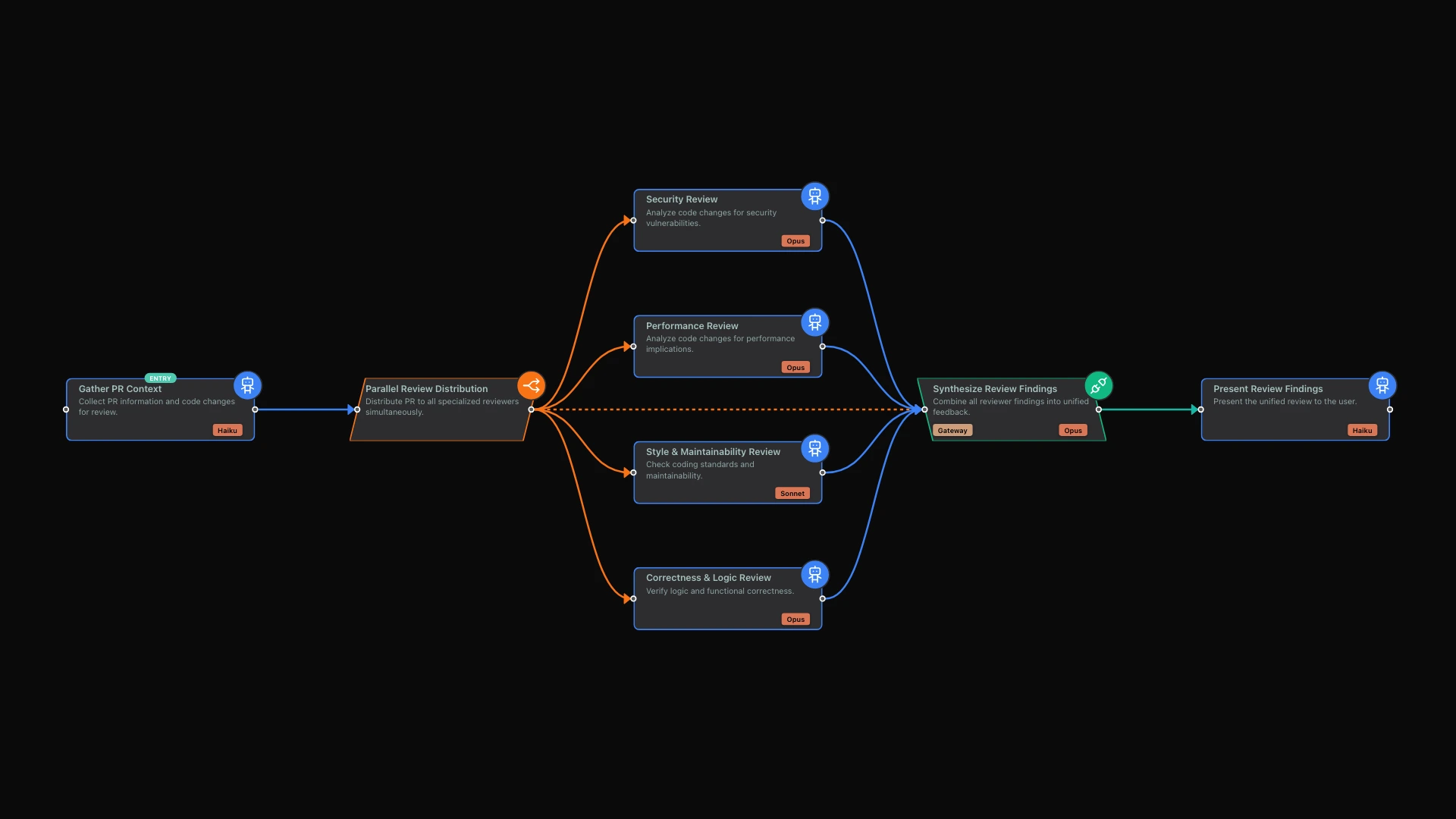
Using limerIQ's visual workflow editor, you can design a review process that distributes work to multiple AI reviewers simultaneously, then synthesizes their findings into a unified review. The experience feels like having a team of specialized experts available on demand.
First, the system gathers context about your pull request. It examines the changes, understands the scope, and prepares the relevant code for analysis.
Then, four specialized reviewers analyze the code at the same time:
-
A security expert examines the changes for vulnerabilities, checking for SQL injection, cross-site scripting, improper authentication, sensitive data exposure, and input validation issues.
-
A performance analyst evaluates algorithmic efficiency, resource usage, potential bottlenecks, and scalability concerns.
-
A style guardian ensures the code follows your team's conventions, assesses maintainability, and checks documentation quality.
-
A correctness verifier validates logic, catches potential bugs, and confirms the code actually accomplishes what it should.
All four analyses happen in parallel. While one reviewer is examining security, the others are simultaneously checking their respective domains.
Finally, an integration step waits for all reviewers to complete, then synthesizes their findings into a single, prioritized report. You receive one coherent review that covers all perspectives, organized by severity and actionability.
Intelligent Resource Allocation
Not all review tasks require the same level of analysis depth. limerIQ allows you to configure each reviewer appropriately:
Security and correctness reviews - which catch bugs and vulnerabilities - receive deeper analytical attention. These are where mistakes cost the most, so the system applies more reasoning power.
Style reviews, which focus more on pattern matching and convention checking, can operate with lighter analysis. This keeps costs optimized while ensuring critical reviews get full attention.
The visual editor makes it easy to tune these settings without touching configuration files.
The 5x Throughput Reality
How do teams achieve dramatic review throughput improvements?
Consider a traditional sequential review process:
- Waiting for reviewer 1: 4 hours
- Review time: 30 minutes
- Waiting for reviewer 2: 6 hours
- Review time: 30 minutes
- Waiting for reviewer 3: 8 hours
- Review time: 30 minutes
- Waiting for reviewer 4: 4 hours
- Review time: 30 minutes
- Total: approximately 24 hours elapsed time
With parallel AI review:
- Gather context: 2 minutes
- All four reviews (simultaneously): 5 minutes
- Integration: 2 minutes
- Total: approximately 9 minutes elapsed time
The "5x throughput" claim is actually conservative. In practice, teams report even greater improvements because:
- No waiting for human availability
- Reviews happen 24/7, weekends and holidays included
- Reviewers never have context-switching overhead
- Consistent quality on every PR, regardless of time pressure
Beyond Basic Review
The parallel review approach enables sophisticated review configurations that would be impractical with human-only teams.
Consensus-Based Approval: Configure multiple reviewers to vote on whether to approve, with thresholds you define. Perhaps three of four reviewers must approve, or all security concerns must be addressed regardless of other feedback.
Competing Approaches: Run different review methodologies in parallel and select the most thorough analysis. This is particularly valuable when exploring new review criteria.
Custom Integration Logic: Define exactly how findings should be combined. For example, any critical security issue automatically blocks the PR, while style suggestions are collected as optional improvements.
The visual workflow editor makes these configurations accessible without requiring deep technical knowledge.
The Human-AI Collaboration Model
Parallel AI review does not eliminate human judgment. It augments it. The AI handles the comprehensive scanning that humans find tedious and error-prone. Human reviewers can then focus on:
- Architectural considerations the AI might miss
- Business logic validation requiring domain expertise
- Mentorship opportunities with junior developers
- Design decisions that require team discussion
Your senior engineers stop spending hours on repetitive review tasks. They start spending minutes reviewing AI-synthesized findings and adding their unique human insights.
Getting Started
Setting up parallel code review for your team is straightforward:
-
Open the workflow in limerIQ's visual editor - Start with the parallel code review template and customize it for your needs.
-
Configure your review criteria - Adjust what each specialized reviewer checks based on your team's standards and priorities.
-
Set up team personas - Create custom reviewer profiles that encode your team's expertise and preferences, ensuring the AI understands your conventions.
-
Integrate with your workflow - Connect to your CI/CD pipeline for automatic reviews on PR creation.
-
Iterate based on feedback - Review the synthesized feedback and refine reviewer criteria based on what your team finds most valuable.
The Strategic Impact
Code review bottlenecks are a solved problem. With limerIQ's parallel review approach, you can:
- Run multiple specialized reviews simultaneously
- Get comprehensive feedback in minutes, not days
- Maintain consistent review quality across all PRs
- Free your senior engineers for higher-value work
- Scale review capacity without scaling headcount
The parallel code review workflow demonstrates a fundamental shift in how engineering teams can operate. Instead of coordinating human schedules, you orchestrate AI specialists that are always available, always thorough, and always fast.
Your team's velocity is waiting. Stop letting PRs sit in review limbo.